Entering my 3rd year practicing "raw food" veganism. Fong-ming (芳鳴) (University researcher, currently working and living in Taipei)
Origin
In April 2023, I watched an interview with Dr. Simon Chau ("Brother Cheung" 祥哥) on YouTube. After watching the video about the seasonality of fruits, I felt I had learned something about eating in accordance with nature. Soon after, I saw an interview with Dr. Chau by Wellen, where they mentioned "raw food", and I was deeply attracted by the green smoothie that Wellen and "Brother Cheung" (祥哥, Dr. Chau) were holding. I am not physically strong, and for many years I have mainly consulted a traditional Chinese medicine practitioner. I have given up frozen food and drinks for many years, and I almost never eat salads. My diet is light, I eat brown rice, and I get my nutrition from high-quality meat and eggs. I also pay attention to eating vegetables and fruits, and I feel that my diet is healthier than most people. I also take high-quality health supplements. Some time after the pandemic, I had an abdominal ultrasound and was told that I had fatty liver and fatty pancreas, which shocked me. It was August, summer, and I always felt hot, uncomfortable, and easily tired. I've seen health programs and articles suggesting that fatty liver, sometimes called "fruit liver," is related to excessive fruit consumption. I do love fruit! For my health, I changed my eating habits, adopting a strategy recommended for diabetics. I eat plenty of vegetables and save my rice for last. I reduce most of my fruit intake and only eat white meat occasionally. I also started exercising outdoors, walking 30-45 minutes in the park daily. After three months, I felt much lighter. The weight I gained during the pandemic has also significantly decreased.
This 8-month adjustment happened before I saw the "raw food" videos. For the first three months after seeing them, I still felt tired after meals. Also, I started to find cooking similar vegetables in one pot monotonous.
When I was drawn to that green smoothie, I needed to complete an important task at work in a short time, and I felt it was time to comprehensively improve my physical and mental well-being and work efficiency. After watching several videos, I found the effects of raw food on vitality and spirit very appealing. Soon after, I tasted my first glass of fruit and vegetable syrup and found it delicious; my cells loved it, I felt refreshed, and my mood was cheerful. I felt my blood was already full of nutrients, and that further supplementation might exceed my limits, so I stopped taking supplements, something I'd been doing for over ten years.
About 2 days later, I continued my usual routine, cooking and preparing dinner. Sitting down at the table, I suddenly noticed an unpleasant smell emanating from the steamed fish pieces. After one bite, I didn't want to eat any more. A thought quickly crossed my mind: "Enough!" Just like that, I realized I'd had enough of my previous eating habits. After that, I drastically shifted towards a raw food diet. I began systematically learning and practicing from videos, online information, and public library books. I looked forward to new learning each day, taking small steps each day, finding it fresh and interesting. At that time, I didn't intend to become completely raw; I was just trying it out. For the first two months, I still maintained my proud practice of making my own sprouted black soybean milk (using a Korean Joyoung brand automatic soy milk and nut milk maker, and it even had an automatic cleaning function). Gradually, I realized I no longer needed even sprouted black soybean milk, and began to eat almost entirely raw food. (Sometimes I still eat it when having hot tea with family and friends.) Being able to eat more fresh fruit made me truly happy! As for how to eat vegetables, what kind to eat, how much to eat, and the temperature to eat them, these are all topics I'm carefully learning and experimenting with.
After adopting a raw food diet, I experienced wonderful feelings in my body and mind. My learning efficiency improved, and when practicing various spiritual disciplines and transformations, I was more self-aware, more likely to encounter helpful people, and more likely to see results. My weight dropped by about 10 kilograms in about one or two months. My colleagues and family were mostly worried when they saw how much weight I had lost in my face and body. But some also noticed I looked more energetic and gave me envious glances. I didn't mind the process because I experienced a more vibrant change. At the same time, I also looked forward to my weight gradually returning after the transition period. (Indeed, I've already gained back 4-5 kilograms.)
When I returned to Hong Kong from June to August 2024, I had been eating raw food for a year. While searching online for platforms selling organic fruits and vegetables (in Taiwan, I frequently buy from organic stores and fruit shops through Uber Eats, my own app, website, or Line groups, and occasionally from physical stores), I was delighted to find the "Healthy Express" website platform. I met Mr. Li Ka-Hung through ordering groceries and was invited to share my experience with raw food on the platform. At that time, I had just enrolled in a basic raw food course at Green Forest Food Training Center, gaining more information, opportunities for exchange, and confirmation. Raw food requires learning and practice simultaneously, and I am very grateful to all the teachers who have helped me increase my knowledge and inspire my practice over the past two years, as well as to the farmers and businesses that cultivate and sell natural fruits and vegetables. On this platform, I take the opportunity to share my daily practices, the information I've used, commonly used ingredients, and the platforms I purchase from.
Daily Diet: Handling and Pairing
1) Temperature: If the food or ambient temperature is low, and it's impossible to directly sun-dry the food to room temperature or lukewarm, I've used different appliances for heating. At home in Taiwan, I used a Taiwanese "Tatung" electric rice cooker (大同電鍋) (I used a Wanngwo brand (萬國牌); I added a few drops of water, or none in summer, pressed the button, closed the lid, and waited for the food to heat up inside. After the button popped up, I waited a moment for the heat to penetrate the food before opening the lid). In Hong Kong and Europe, I used my family's or apartment's electric oven, adjusting the temperature myself. When traveling to other places where an electric oven wasn't readily available, I later found a silicone collapsible mini steamer with a steaming rack.
Optimal Temperature: Food above 41 degrees Celsius will destroy natural enzymes and nutrients. (In Taiwan, I've heard of 45 degrees Celsius.) The ideal heating environment temperature needs to be determined by the individual. Without experience, I used a food thermometer to measure and feel the food's temperature. Later, with more understanding and experience, I stopped relying on the thermometer.
2) Food Preservation: Properly storing fresh vegetables and fruits to extend their freshness and viability is a daily routine. During my trip back to Hong Kong in the summer of 2024, I visited the Tai Po Weekend Farmers Market. From farmer Kam Je's Organic Farm stall and LI Ka-Hung, I learned to use paper + plastic bags, plastic bags + cotton cloth, or paper + plastic bags + cotton cloth to preserve vegetables, especially leafy greens, particularly in summer. Previously in Taiwan, I used paper + plastic bags to wrap bananas and store them in the refrigerator (because they were ripe enough but I didn't have time to eat them). Later, following Sister Qin's advice, I started using cotton cloth. Ka-Hung actually gave me several very nice cotton cloth bags when I did large-scale grocery shopping. I find these cloth bags very convenient for people like me who can't spend time grocery shopping every day.
3) Sunbathing: Directly exposing food to sunlight is beneficial. For refrigerated food or food stored at room temperature in winter, direct sunlight can warm it up (in winter, sunbathing alone may not be enough to warm it, requiring further heating later), while also providing the sun's energy.
Note! During bee season, such as summer, it's not recommended to leave fruit on the balcony to dry. Bees will be attracted, and if one likes it, they will swarm. I tried this once in Hong Kong! You can cover drinks and leave them to dry. Glass cups can absorb solar energy. However, be mindful of the glass's color; anything not neutral and transparent carries some kind of energy. Blue glasses suit me well.
(Regarding bees, I later discovered that applying a little pure natural peppermint essential oil to the skin can repel bees.)
4) Food Classification and Combinations
A general recommendation for the proportions of raw food ingredients is, by weight, approximately 75% fruit, 20% vegetables, and 5% nuts.
When I first started learning about raw foods, I studied Dr. Simon Chau's *The Raw Food Diet Handbook* (《生機飲食手冊》), focusing particularly on Chapter Seven, "The Art of Food Combinations" (食物配搭的藝術). Based on the different types of substances the body secretes during digestion, and to maximize digestive benefits, the nutrition community has categorized foods in various ways. These classifications provide important guidelines for choosing ingredients and the order in which they are eaten. This knowledge may not seem new, but reading it revealed how limited and incomplete my previous understanding was.
Based on the needs of food combinations, these categories include: vegetables, proteins, starches, fruits, and melons.
Each category also has many subcategories.
For example: Fruits can be categorized as slightly acidic, weakly acidic, and sweet. Proteins can be categorized as nuts, seeds, pods (not all things labeled "beans" are beans), and fruits (such as coconuts). (For meat-eaters, this also includes non-plant-based meats, eggs, dairy, and seafood.)
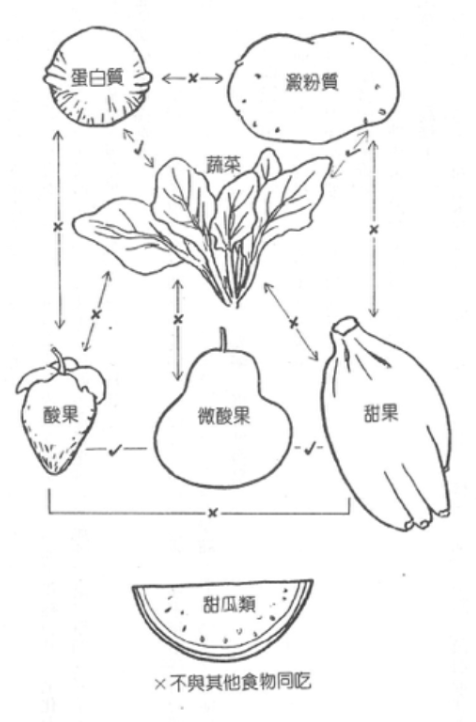
The diagram below shows recommendations for optimal food combinations across the five food groups (The Raw Food Handbook, 《生機飲食手冊》p. 62):
* Melons and sweet fruits (e.g., durian) should be eaten alone, not in combination with other categories.
** Sweet fruits eaten alone are not shown in the diagram below. However, they are mentioned in the later book *Raw Food*《食生》. (Not shown in the diagram below)
Dr. Simon Chau later published two books titled *Raw Food*《食生》, presenting these principles in different layouts. Excerpts are as follows:
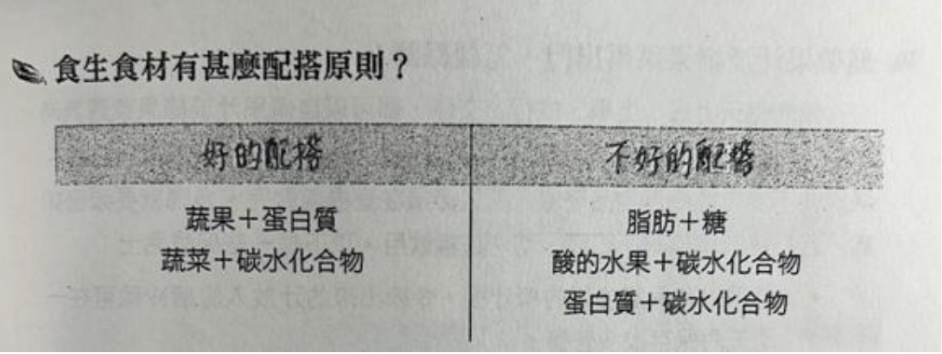
(*Raw Food: A Practical Guide*《食生:實踐版》, p. 49)
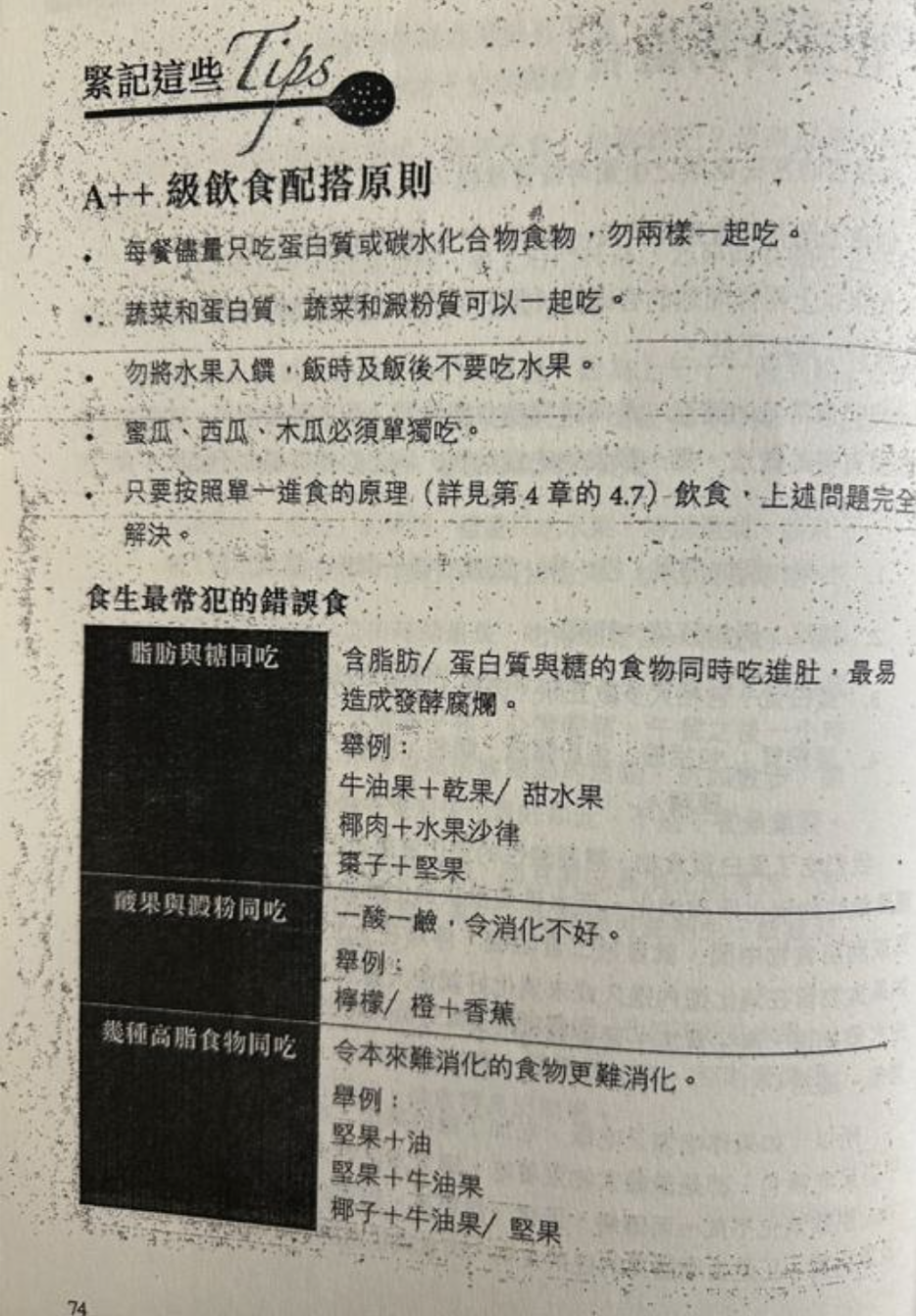
(*Raw Food: The A++ Diet for a Healthy 21st Century*《食生:21世紀不病不老的A++級飲食法》, p. 74)
* "Do not incorporate fruit into dishes" (勿將水果入饌) likely does not include situations where fruit is the sole main meal. Many raw food enthusiasts gradually shift towards a fruit-based diet.
Regarding which foods belong to which category, I might be biased by preconceived notions, but I still prefer Chapter 7 of the text-heavy *The Raw Food Handbook*《生機飲食手冊》.
The general principles of food pairings (see the first image above, from *The Raw Food Handbook*《生機飲食手冊》) are that there are exceptions based on the specific properties of certain foods. As a beginner in raw food, I'm particularly curious about these "exceptional" combinations:
Tomatoes, although classified as "fruits," are generally not suitable to eat with vegetables. However, they are suitable to eat with less sweet vegetables, such as lettuce (萵苣), cucumber, bell peppers, and eggplant.
*Bell peppers: I recall seeing them paired with tomatoes in another book published around the same time, a large-print version with illustrations. I've returned the book to the library; I'll borrow it again sometime.
Avocado: This high-fat "fruit" (I'll look it up separately) is classified as a high-protein food in the book (I think the protein content may vary considerably between different varieties). Interestingly, this "protein" fruit pairs well with "acidic or slightly acidic fruits" (page 60)—especially tomatoes—and also with "starchy vegetables" (page 59), such as corn.
Unsuitable combinations: With other proteins or fats (e.g., nuts, seeds, coconut). Raw lettuce: Suitable to eat with fruit (page 60).
For general eaters (not raw food eaters), one exception is particularly useful: Eating legumes and grains together is generally fine (page 59). Eating legumes and whole grains together is also fine (page 63).
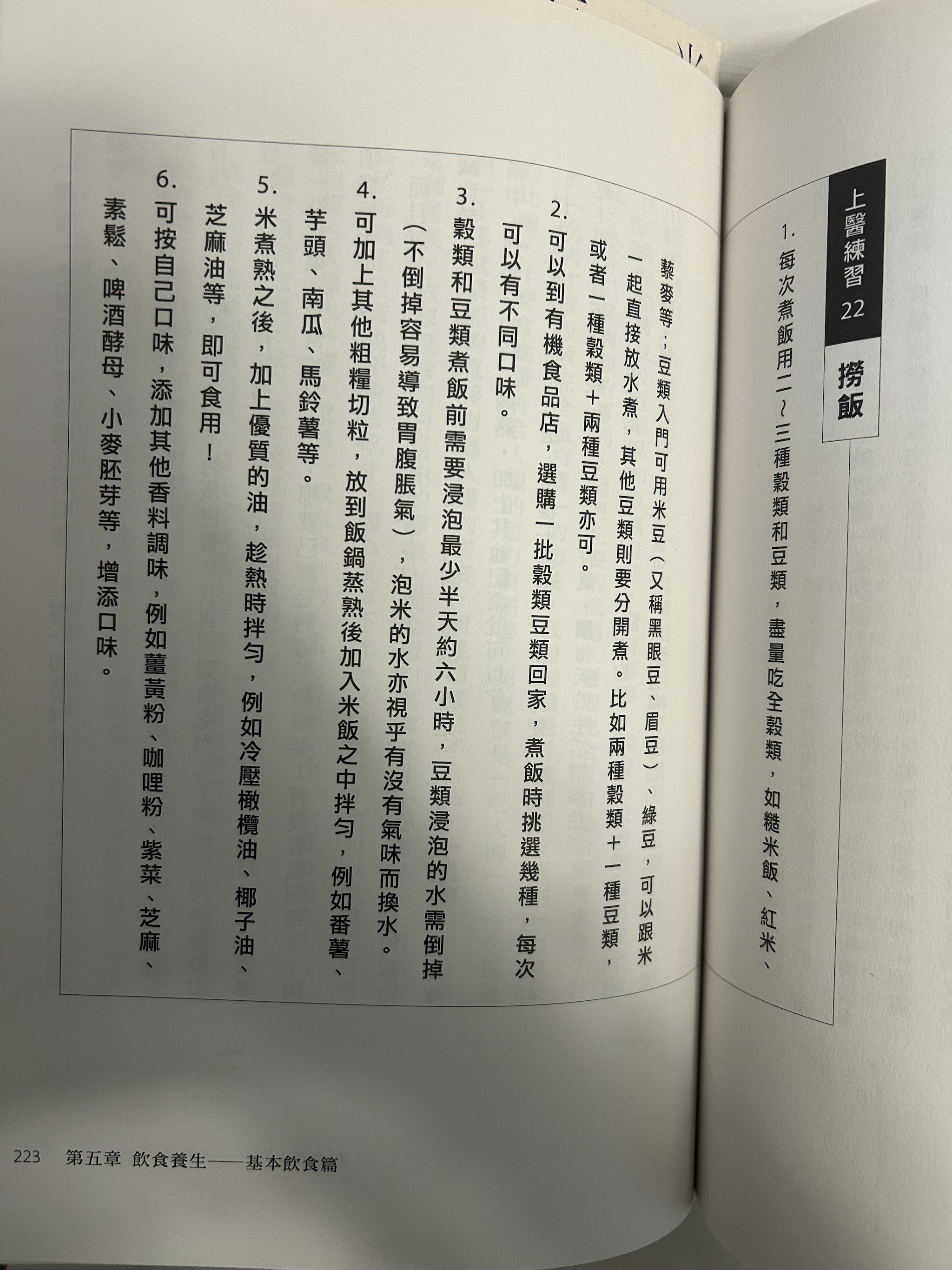
Legumes: Later, I read Dr. Lee's *Skillful Doctor's Method of Nourishing Life*《上醫養生法》, which encouraged readers to try vegetarian recipes, including "Lao Fan" (撈飯) (Skillful Doctor's Exercises 上醫練習 p. 222-226), which involves soaking whole grains (such as brown rice, quinoa, etc.) and legumes, cooking them, and then "lao" them. Legumes vary in type; some beans (like black-eyed peas and mung beans) can be cooked with rice, while others should be cooked separately. (The water used to soak the beans should be discarded, as it can cause bloating). Later, I saw a video of Dr. Lee's daily diet (on a talk show RTHK's 鏗鏘集?), where Mrs. Lee prepared a kind of "lao fan" (rice with rice). Shortly after, I also saw a video of Dr. Chou Wah-shan's daily diet from the Dreams Possible (自在社), showing an expanded version of "lao fan".
I was curious about the classification of legumes. It turns out it's quite complex. Based on recent data cited by Taiwanese nutritionists on government platforms (such as the Food and Agriculture Education Information Platform (食農教育資訊平台)) and health food sales platforms (such as the Taiwan Homemakers' Union Consumer Cooperative (台灣主婦聯盟生活消費合作社)), the *Raw Food Diet Handbook*《生機飲食手冊》 mentions that besides legumes classified as "protein" (including soybeans, black beans, and edamame (黃豆、黑豆、毛豆)), there are also "starch" legumes (such as red beans, mung beans, green beans, chickpeas, and black-eyed peas (紅豆、綠豆、青豆、鷹嘴豆、眉豆)).
(The aforementioned Taiwanese platform also offers a third category, "Vegetables," including snow peas, snap beans, and string beans (荷蘭豆、四季豆、豆角)).
Beans need to be cooked before they are suitable for human consumption. (Dr. Chau mentioned that beans are suitable for birds, while humans, being primates, are best suited to eat fruit). Raw food enthusiasts don't eat cooked rice, but they do eat fermented foods made from cooked beans (miso, tempeh), because the fermentation process produces live beneficial bacteria.
After this period of learning and practice, I have established personal eating habits that basically conform to these pairing principles. I also admit that there are times when I break the rules. For example, I used to bring nuts with me for occasional snacks, but later I liked to add some organic raisins, finding it tasted better. According to health principles, nuts, which are high in protein and fat, should not be eaten with dried fruits, which are considered "sweet fruits." I eat very small amounts, and only when I'm truly hungry, so I can still accept it for now. (I don't rule out the possibility that one day I will abandon this pairing!)
Daily Diet: Ingredients and Cooking Methods
1) Smoothie
My most common basic combination is:
- Bananas (ripe and speckled; in Hong Kong, I also use plantains) +
- Apples (organic apples, whole, core and all, cut into chunks; non-organic apples are less common and I'll consider peeling) +
- Leafy greens such as sweet potato leaves / spinach / kale / komatsuna (seems only available in Taiwan) / kale / amaranth (only use leaves, not stems; use vigorous leaves, the rest can be recycled. Wash the vegetables briefly, preferably with good filtered water)
- Coconut water (I mix warm and hot water in winter)
In the past year (2025), I've added:
- Bell peppers (only red or yellow, not green)
Other ingredients:
- Longan (2-4, depending on need. Don't add if you have excessive internal heat. If very hard, soak in water to soften)
- Fennel seeds (A few pieces. Do not add if you have excessive internal heat)
- Beetroot powder (one small spoonful. You can alternate with the above two, or add all of them, depending on your body's needs)
- Ginger (add a very, very small amount, depending on your needs. I don't add it at night)
Note:
- Leafy greens should be varied; don't use only one type. I rotate them, changing them about every 1-2 days.
- Whether to add bananas, and how much, can be adjusted according to your body's needs. Occasionally, I don't add bananas (especially at dinner), and longan/beetroot powder can provide sweetness and rich nutrition. Sometimes I feel I've absorbed enough sugar that day, so I don't add longan/beetroot powder, just apples and bell peppers.
More sharing:
My first fruit and vegetable smoothie was freshly made at the 健康食彩 organic store in Taiwan (now part of the Cotton Field (棉花田) franchise). In Taiwan, it's called a green latte/energy soup. That cup contained apples, pineapples, and leafy greens (not sure which kind), sweet and sour, and very delicious. Taiwanese green lattes/smoothies usually contain nuts and raisins. My first one included them too.
Later, at a course at Greenwoods Smoothie, the instructors advised against adding oily ingredients, such as nuts and seeds, to fruit and vegetable smoothies, as they believed it hindered absorption. Previously, I'd heard from Dr. Irene Lo's lectures that she sometimes added flaxseed, especially in winter, and found it gave her more energy (if I remember correctly). I tried it for a while with a small amount of flaxseed and found it quite good. Gradually, I stopped this habit, and it seemed fine.
I prefer fruit, without leafy greens, and occasionally I use dragon fruit with blueberries. (A friend, following Anthony William—author of *Medical Medium* (《醫療靈媒》), shared with me the detox benefits of a dragon fruit and blueberry smoothie, and drinks it almost every morning.)
High-speed blender
A Vitamix (E310/E320) from the US (available in Taiwan, Hong Kong, the UK, and Shanghai)
In Germany, I bought a WMF (Kult Pro High-Speed blender)
2) Fruit
Fruit smoothies are "pre-digested" foods, aiding in absorption. Around the second year, after my body had absorbed many nutrients, I stopped drinking it every day. From then until now, I rely more on fresh fruit daily. The sugar in fruit is a major source of calories (energy) for those who prefer a raw food diet.
Fruits I frequently eat include dragon fruit (red-fleshed dragon fruit), grapes (Taiwanese Kyoho grapes), and papaya (I can eat a large one in one meal). Bananas and plantains (a Hong Kong variety I really like) are always on hand. In summer, I eat a lot of mangoes, peaches, durians, longans, oranges, and cantaloupes. Watermelon is also good for cooling down. Pineapples are readily available in Taiwan, but it depends on your health; they're more common in summer. In autumn and winter, I eat a little persimmon, and more citrus fruits, which are in season during winter. Custard apples, figs, and golden apples are also readily available in Taiwan, and I eat them all. Pears are also available, and I mainly eat them when the weather is drier. Cherry tomatoes are also a frequent choice; they're especially delicious in Taiwan during winter.
I mostly use apples at home to make fruit and vegetable syrups, and I rarely eat them on their own. When taking long flights, I bring apples (or pears), bananas, and citrus fruits (in winter) because they're convenient and healthy.
Strawberries: I spent the last two summers living in Germany and the UK, and I found the seasonal varieties there to be delicious. Even the expensive ones in Taiwan always seem to lack something—they're not sweet enough to satisfy me. As for blueberries, the seasonal ones in Germany and the UK are delicious in summer. In Taiwan, organic stores offer carefully selected produce in the summer, which I enjoy during the season. However, I usually stock up on organic blueberry juice when it's on sale, just to drink when I need it.
Avocado and coconut: Botanically, they belong to the fruit category, but due to their high oil content, I generally don't eat them as fruit. I'll mention avocado (called "luoli" (酪梨) in Taiwan) in the "Salads" section below, and coconut meat in the "Snacks" section below.
Interesting Discovery
Longan and durian: I probably wouldn't have dared to eat them for decades because I was afraid of getting a sore throat and other heat-related symptoms. After adopting a raw diet, my tendency to get heat-related symptoms hasn't completely disappeared, but it's better than before. Shortly after adopting a raw diet in June 2023, I learned about colon hydrotherapy from Dr. Chau and found the Water Angel Colon Hydrotherapy Center in Taipei (near Zhongxiao Dunhua MRT Station, Mingyao Department Store). One day, after leaving Water Angel, I felt a bit weak. I happened to pass a temporary fruit stand and saw longan; suddenly, I really wanted to eat some. I bought some to try and see how it reacted, and I immediately fell in love with it. I ate a whole bowl of it, feeling my body really needed longan. (Later, my mom told me that when she was pregnant with me, she ate longan frequently for a period of time. Maybe I already liked longan before I was born.)
Durian, I didn't start eating it until my second year of a raw food diet. I heard a video by Dr. Chau mentioning the rich nutrition of durian, which might be particularly appealing to raw food enthusiasts. I was tempted to try it. Finally, in 2024, when I went back to Hong Kong for summer vacation, I bought a box at Wellcome to try. One bite, and I fell in love with it. Even when I'm in Europe, I buy frozen durian from Asian supermarkets, thaw it, and eat it to absorb its nutrients.
Purchase Platforms (Organic/Selected/Regular)
Seasonal fruits are best. For fruits that are eaten with the peel, I try to eat organic or selected from organic stores. For fruits without organic certification, I try to buy from platforms that claim to be toxin-free and soil-friendly. I also choose high-quality fruits from traditional fruit stores.
In Taiwan, there are more options. I often buy organic products from Green & Safe and 台灣棉花田.
In Hong Kong, I buy organic or high-quality fruits from Healthy Express, and also from markets or supermarkets near my home (North District, New Territories).
3) Salad
(1) Bean sprouts
Mung bean sprouts, alfalfa sprouts, others (green flower sprouts and purple Korean pea sprouts can be bought at Cotton Field in Taiwan; sometimes fenugreek sprouts 葫蘆巴芽 and radish sprouts 蘿蔔嬰 are also available). Sprouts are important for boosting energy.
I sometimes grow my own mung bean sprouts. It's not difficult as long as you prepare the necessary equipment:
- A basin, a strainer, and a basin lid; you can also use a self-sounding kettle (after covering the spout, tilt the kettle to let the water flow out).
- Soak overnight, then drain the water. Then "bathe" the mung beans morning and evening (add water and strain out the water). Depending on the season and room temperature, the sprouts will emerge in 2-4 days and are ready to eat shortly after. You can let them grow for a longer time, adding 1-2 days. Their vitality is at its peak when the sprouts have just emerged. I learn from Green Forest's method of raising them myself, harvesting them for consumption in a short time.
Mung bean sprouts are generally available in Taiwanese organic stores, unless they're sold out. I accept that the sprouts are relatively long.
Some sprouts are quite spicy. Mung bean sprouts and alfalfa sprouts are not spicy and make a good pairing.
(2) Lettuce (including Indian lettuce) or other leafy greens
- I generally use lettuce, which is easy to digest. I also try to use the leafy parts, as the white parts feel a bit too cool.
- Use organic or high-quality broccoli, use only the florets, not the stems. Soak it in salt water first, raising the water temperature to around 41 degrees Celsius, for about half an hour. The same method can be used for other leafy greens, as Dr. Irene Lo has suggested. However, I rarely practice with other leafy greens.
(3) Avocado
Ripen avocados are delicious. I've encountered unripe ones and overripe ones, and in the end, I had to remove the black parts or even throw the whole avocado away. When I find one that's just right, I'm very happy. If I can't eat the one I bought, there's no need to be angry. If the shopkeeper is easy to communicate with, then communicate; sometimes, there's no need to say much. The more you buy and eat, the more experience you gain. Keep a grateful and open mind and look forward. There's no need to make things unpleasant about avocados, and the same goes for other ingredients. If you can't eat it, just let it be. Adding a little black salt (containing sulfur) makes it taste like eating preserved eggs. Adding lemon juice (squeezed beforehand) can slow down the oxidation process. If it's fresh enough, it can be kept in the refrigerator for 1-2 days. It goes very well with tomatoes. "Salad Rolls": Sometimes it's paired with homemade sesame paste (lemon juice, natural black/white sesame paste, good oils such as low-temperature sesame oil/flaxseed oil), and mung bean sprouts (or other sprouts, but not soybean sprouts), occasionally...
Shredded carrots and fennel seeds are rolled up in large sheets of seaweed (see below).
(4) Coral Grass
Soaking time varies from 2 to 12 hours, depending on the firmness of the produce. Depending on the type and cleanliness, it is generally washed 3 times before soaking. If soaking time exceeds 2 hours, remember to change the water in the middle.
Besides coral grass, there are also sea bamboo fungus and sea velvet heads, which require shorter soaking times. The different types of "seaweed" have different textures, so soak and eat them in rotation.
(5) Pickles
German pickles (Sauerkraut, kraut) are fermented using only salt, without vinegar. I bought homemade ones because I had tried making them at home, but they spoiled, probably due to the hot weather or something else. I fell in love with German pickles because the salad served in a restaurant in Freiburg, Germany, was very delicious. I also bought some at a farmers' market in Munich, which was equally fresh and appetizing. Later, I discovered that they can also be used for seasoning, reducing the need for sauces. Rich in probiotics, adding nutrition.
In Hong Kong, Greenwoods (綠野林餐廳) makes its own Korean kimchi. I don't like spicy food, so I prefer the non-spicy versions from Foodcraft, which have many varieties to choose from (search "fermented food" on the Foodcraft website).
(6) Root vegetables and bulbs:
White radish, carrot, beetroot, cherry radish, fennel bulb, taro, yam, jicama, lily bulb, burdock, ginger
- Potatoes, sweet potatoes, taro, water chestnuts, etc. cannot be eaten raw, but the ones mentioned above can be eaten raw.
- White radish, carrot, beetroot: I usually make vegetable noodles. I eat more white radish than the other two because it is softer and easier to digest.
- Cherry radish, fennel bulb, taro, yam, jicama (found in Hong Kong in summer): I usually shred them. One or two kinds are enough for a meal.
- Yam: During my first summer eating raw food, I saw a video by vegetarian chef Ken Kwong (素食教煮) and vegan mom Grace Wong about "Passion Fruit Yam". They made a fresh jam with passion fruit, mango, and a little lemon, using perilla leaves as a base and topped with fresh yam. The process requires processing the passion fruit seeds first. I tried it then and found it delicious, especially in the summer when mangoes are in season. I haven't spent much time making this jam, but I learned the principles behind it. Not long ago, I returned to Hong Kong, and during winter, I saw some mandarin oranges at home and also bought some purple yam. So I used the mandarin oranges (with peel and seeds) and some coconut water (bought from Wellcome) to make a jam. Since I didn't have perilla leaves, I just added them to the shredded yam and ate it. (Four Seasons Citrus Sauce, of course, can also be added to other vegetables to accompany the dish. A friend came to share and taste it, and especially praised this sauce.)
- For leftover yams, I don't shred them first, but add some lemon juice to the cut side before putting them in the refrigerator to slow down the oxidation.
- Lily bulbs (vegetable), burdock, ginger: I sometimes use them to make fruit and vegetable syrup, but I use very small amounts.
(7) Vegetable Noodles
- I've eaten white radish / green cucumber (called zucchini in Taiwan) / beetroot (small amount) / carrot (small amount)
- I use a noodle maker to cut them into noodle shapes, add homemade sauce, and they're ready to eat. You can also sprinkle some crushed nuts to increase the feeling of fullness. The noodle shape is easy to eat, and I make it every now and then.
(8) Large sheet of nori (sushi nori sheet, roasted seaweed (燒海苔), original flavor, no additives)
I use it to make "salad rolls". (Refer to avocado above)
- For a crispier and tastier texture, it's ideal to air-dry easily softened varieties at a low temperature before rolling them up with vegetables. However, I never take that time. Not all seaweed softens easily, and even if it does, I don't mind chewing it slowly.
(9) Edible Flowers
A small amount can be added to salads, fruit and vegetable syrups, or soups. Different varieties are available on the "Healthy Express" platform; in Taiwan, I bought mine on the "挺農易 Team Farmers" platform.
(10) Specialty Products: "Mexican Corn Chips (墨西哥粟米片)", "Nanyang Raw Papaya Wrap (南洋裸食卷)"
- Mexican Corn Chips
I learned this recipe from Dr. Simon Chau (from *Eat Raw Food in Practice*, pp. 178-179), and I really like it. You'll need a dehydrator first. The ingredients are corn kernels (using a knife or a special grater), yellow bell peppers, flax seeds (crushed into powder first, preferably soaked and then dried), lemon juice, and a small amount of salt. Place parchment paper on one or two racks of the dehydrator, then flatten the dough onto the paper, the thickness depending on your preference. Then, select a low temperature (below 41 degrees Celsius) and dehydrate for about ten hours. Once dried, cut into triangles or other shapes with kitchen scissors. To eat, serve with salsa made from avocado and tomato (with a little lemon juice and salt) for a Mexican-style dish. It's also delicious on its own. I especially love the combination of the refreshing sourness of lemon juice and the saltiness of salt.
Dehydrator:
I used the Excalibur dehydrator sold by Greenfield Foods in the US. 2900, but I bought it on a Taiwanese online shopping platform.
- Raw Papaya Wrap (南洋裸食卷)
In Taiwan, "裸食" is a Chinese translation of "raw food". The Raw Papaya Wrap offered at Plants Eatery is made by mixing papaya flesh into a dough and then air-drying it for over 10 hours. It contains various vegetables, including avocado, bean sprouts, lettuce, and fermented carrot strips. The delicious flavor mainly comes from the spread, made with cashews and other ingredients. The restaurant's spread is normally spicy (Nanyang style), but I don't eat spicy food, so after communicating with the restaurant, we reached an agreement that they could customize a non-spicy spread for me, but I needed to call and reserve it at least one day in advance, and order it again within 2-3 days to allow for sufficient use of the spread. I agreed to this agreement, and it's been over a year now.
Salads, Dressings, Herbs
- Lemon juice (especially coral grass) / Apple cider vinegar (I've used mulberry vinegar in Taiwan)
- Good oils (coconut oil / Flaxseed oil / premium low-temperature sesame oil, etc.
- Coconut oil solidifies at low temperatures, but melts easily with slight heating in winter.
- Honey (coconut honey is preferred; I use maple honey when it's unavailable; I've seen information on land-friendly wild bee honey, which might be worth considering).
- Vanilla powder: flannel/cumin, nutmeg, fenugreek, coriander seeds. Inspired by a curry powder recipe from Dr. Chou, a Taiwanese vanilla expert (but I'm prone to getting a sore throat and can't tolerate the pepper and chili powder Dr. Chou adds). Sprinkle some on salads as needed.
- Black sesame paste / white sesame paste (tahini) / nut butter: mixed with lemon juice/vinegar, some good oil, and possibly honey. Add to salad rolls (make it thicker), or serve with vegetable noodles, etc.
- Organic low-temperature black bean soy sauce / coconut soy sauce (amino)
In the second year of eating raw food, my body had adapted more, and my reliance on seasonings decreased, especially soy sauce, which I rarely use anymore. If there are no other sauces, I find that a little honey alone is delicious.
I always carry a small amount of vanilla powder with me. Sprinkling on suitable herbs can balance warming and cooling properties, aid digestion, and reduce inflammation. Herbs are a field worth learning. I received advice from a chef friend and later discovered that Brother Xiang's "curry powder" is an example of using herbs. Pepper and chili are not suitable for my yin-deficient and fire-excessive constitution, and fennel is already warm enough, so I sometimes omit it.
4) Miso soup, seaweed / kelp, turmeric powder
This combination was learned from Brother Xiang. Besides eating it almost daily at home (usually after digesting fruit, as part of my diet), it's especially suitable for long or short trips when traveling by plane. Salty foods are best eaten in the morning or during the day.
(1) Miso Paste
- Dilute with room temperature or warm water, about one tablespoon per cup. The consistency depends on the brand of miso paste and your own preference.
- Handmade, fresh miso is preferred, and it should not be made from soybeans. In Taiwan, the local handmade fresh miso I found (often ordered from 蓋兒手釀) is made with organic soybeans. (Although I suggested using chickpeas, I haven't seen any yet.) In Hong Kong, Green Wood has homemade chickpea miso, and I've also bought it from the Foodcraft platform. In Germany, all the miso I bought was made from organic soybeans, and in the UK, you can find chickpea miso.
(2) Kelp Sprouts
- Miso paste can be diluted with water to make a "soup" drink. To eat with kelp sprouts, first soak the kelp sprouts in a small amount of water until they soften after a few minutes, then add the miso paste.
- I buy the brand sold in organic stores.
(3) Kelp (Kombu)
- Larger and thicker pieces are used to make "seaweed noodles" (海菜粗麵). Soak for about 30 minutes, then cut into strips, depending on your preferred width. Add miso soup. I don't eat this noodle dish often, but sometimes I feel the need to absorb more of this seaweed and miso soup.
(4) Turmeric powder
- I usually add turmeric powder to my seaweed and miso soup for breakfast.
- There are different types of turmeric powder, some are cool (according to TCM) (Taiwanese brand 台灣豐滿生技, Purple Turmeric 紫薑黃, 紫鬱金), some are warming (Red Turmeric), and I usually eat the middle type (Autumn Turmeric). In European organic stores, I don't see these Taiwanese brand classifications, so I eat it as "middle type" and don't think it's inappropriate.
- There's a saying that turmeric needs to be combined with a little oil to be effective. Some vegan restaurants (such as Plants Eatery in Taipei) mix turmeric powder with a special drink containing nut milk (turmeric and ginger tea), or some friends suggest adding it to oily salad dressings. There's probably some truth to that, but I still prefer to add it to my miso soup. - Be aware of turmeric contraindications. Turmeric may cause uterine bleeding. I did eat eggplant and other vegetables cooked with turmeric powder at my teacher's house in India for three consecutive days, and my uterus did not bleed during my period. For a while afterward, I dared not eat too much turmeric. Now that I don't have menstrual problems, I feel at ease eating a small amount every day. In addition, I found that if you are taking medication, especially "blood thinning drugs" such as aspirin, you should not eat turmeric frequently, as it may easily cause bleeding.
5) Probiotic fermented products: Water kefir (水克菲爾), coconut yogurt, kombucha (康普茶)
(1) Water kefir
I first saw the name water kefir in an article titled "All-Purpose Health-Preserving Green Fruit and Vegetable Dew" (萬能養生綠果菜露) circulated online by Dr. Simon Chau (周博士,祥哥) for RTHK (香港電台). It was the first item on the list of "super-nutritional supplements" near the end. After searching, I learned that kefir is a kind of fungus. The fungus is soaked in water and good sugar. During the process, the fungus consumes sugar and releases different nutrients, probiotics, enzymes, etc. I found a seller on the Taiwanese platform Pinkoi, called Truby (提琉比), who also shared photos and their production process. They have their own website. I purchased my first set of kefir beads from Truby on Pinkoi (提琉比在Pinkoi). After receiving them, I put them in a glass jar at home and stored them in the refrigerator.
Initially, after drinking the kefir, I felt invigorated. This lasted for about a month. I introduced it to a few students, and each had different reactions. Even though some of my existing skin problems surfaced, the students felt it was a positive reaction. (She also used it with a fruit and vegetable syrup I made; she slept well that night and felt energetic the next day.)
(Later, around the second year, I started drinking Truby's brown sugar brew. Sometimes it felt like a relaxing intoxication, and sometimes it supplemented my nutrition when I was too busy with work to eat properly.)
You can find many tutorial videos on YouTube. I think Chef Ken's "Vegetarian Cooking Tutorial" raw food series (Ken Kwong 廚師《素食教煮》raw food系列:水克菲爾特飲) in Hong Kong explains it very clearly: the ratio is one tablespoon of starter culture to about 500ml of water and two tablespoons of sugar (I always use coconut sugar alone, while Chef Ken uses half coconut sugar and half raw cane sugar). This is a rough ratio. Depending on the season, room temperature, the environment during the process, and one's mindset, fermentation takes about 3 days (longer in winter when the temperature is low). According to Tilubi's sharing on Pinkoi, it generally doesn't take more than 7 days.
If successful, the water should have a slightly sour taste, no longer just "sugar water". When the starter culture is active, it will release bubbles, turning the water into "sparkling water." In my experience, sometimes there are more bubbles, sometimes fewer.
The following year, due to travel, I left the starter culture in the refrigerator unused for two and a half months. When I returned, I felt the activity level of the starter culture was weaker than before, and I suspected it was time to replace it. So, I bought another pack from Tilubi's Pinkoi platform. This time, the starter culture was darker in color and smaller. I contacted Tirubi and learned that they use brown sugar to cultivate the mycelium, which produces smaller mycelium compared to my coconut sugar method. (Tirubi praised the plumpness of my coconut sugar-cultured mycelium after seeing the photos I sent.) I didn't completely discard my original batch; I alternated between my new batch and my old ones, comparing them. After a while, I couldn't distinguish between the first and second batches anymore.
The main issue is that each time I ferment, the mycelium multiplies normally. (Initially, I gave some to several students and friends, but I stopped later). Therefore, I need to discard some after each fermentation; the smaller ones are discarded.
Throughout the process, please note:
- Dissolve the sugar in water first, then add the mycelium.- Do not touch the mycelium with metal tools to avoid killing it.- Required tools:
- Glass jars:1. A jar for fermentation, 2. A jar for storing the mycelium to be used. Fermentation Container: If sealing the container during fermentation, do not tighten it completely. Loosen the lid periodically to release air bubbles and prevent excessive gas buildup. Alternatively, cover with edible gauze and secure with a rubber band.- Measuring Spoon: Used to measure 1. sugar, 2. starter culture (do not use metal utensils).- Stirring Spoon or Chopsticks, etc.- Filter Screen: After fermentation, filter out the starter culture to separate it from the water. Do not use a filter made of edible metal.- Dispensing Funnel: Pour the prepared kefir liquid through a funnel into glass/good quality metal bottles for later consumption.
- Kefir will continue to ferment in the bottle even without starter culture. Like opening any sparkling beverage, avoid shaking and try to loosen the lid periodically to release gas. I tried pouring fruit and vegetable syrup into a bottle that had previously contained kefir, without cleaning it properly or leaving a little kefir, and then went out. Several hours later, when I opened the bottle, something went wrong. The lid was partially open, and the fruit and vegetable juice was spilling out. Moreover, the bottle was full of gas, making it initially very difficult to open. With tremendous effort and a prayerful spirit, we finally managed to open the lid, and the juice overflowed. My sister and I carefully cleaned up the mess on a public bench outside the Eslite Bookstore restroom, then burst into laughter. Unbelievable!
Photo Sharing:
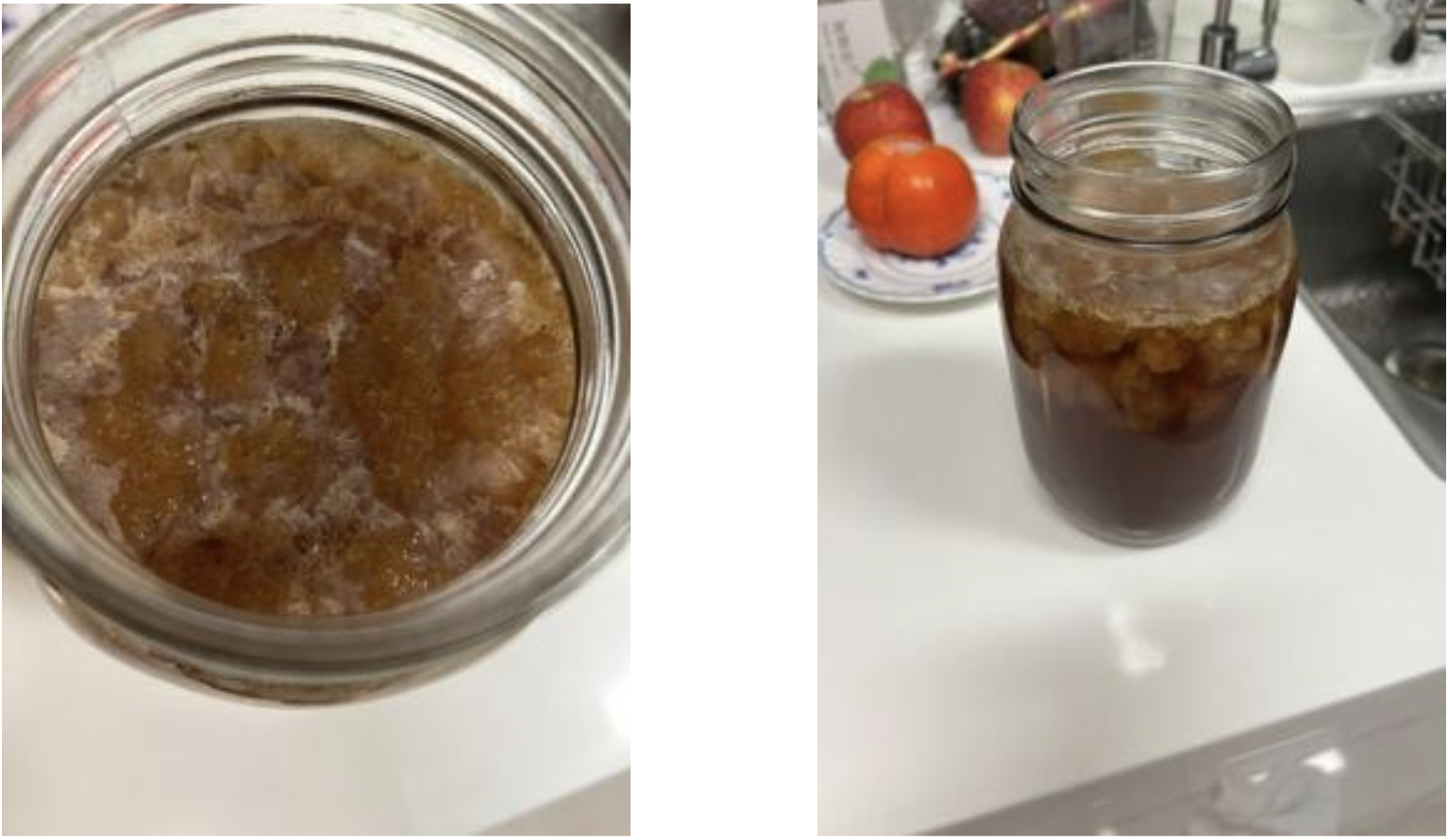
This was in October 2025, after returning home from a two-week trip, take the old bacteria beads out of the refrigerator for about two days after soaking the effect. Bacteria beads are still active! I merely used coconut sugar (the volume of mushroom beads would be a little larger), and maybe the amount of sugar and mushroom beads, slightly more than what Chef Ken recommended. (I intend to adjust this "put a little more" habit next time to experiment and experience the effect.)
(2) Coconut Yogurt
Not long after I started eating raw, I made and tasted it according to Dr. Chau's recipe ("Eating raw Practice Edition" page 106) and found it very delicious and enhanced my satiety. In Taiwan I found a shop in Kaohsiung selling freshly peeled coconut meat and shipped it frozen to Taipei on the shrimp skin (shopee) platform. At first I also bought my own coconut greens back, peeled them myself and then dug out the coconut green flesh. But later I felt I didn't want to spend time processing, and the new knife I bought back was still not strong and sharp enough, since there was one from Kaohsiung, which was good, so I stopped peeling coconuts myself.
For Dr. Simon Chau's recipe, stir coconut meat, coconut water, lemon juice, and kefir to the consistency you want, then place in a glass bottle, cover with cotton gauze and leave in a corner to ferment for about 12 hours.
Later, I found a company in Taiwan that has made using coconut milk and other ingredients for sale (MoonLab), but I heard that the producer has a physical condition and has been suspended for six months. During my visits to the United States, I bought plant-based yogurt containing coconut milk or cashew ingredients at Amazon.com’s Whole Food Market platform and at Trader Joe’s physical storefronts. These American products are acceptable, but in fact, most of them contain soybean ingredients, which I think is not the best. However I also accepted also took for two weeks.
I recently went back to Hong Kong and found out that the "Raw Coconut Original Flavor Yogurt" has been added to the Healthy Express platform. I am very excited! The ingredients used coconut (coconut milk, coconut water, coconut meat), very simple. (The bacteria were too late to inquire about Ka-Hung). On the way back to Taiwan, at noon, I ate half a bottle in one go at the Hong Kong airport and shared the other half with my mother who sent me to the airport (yogurt cannot pass the airport security check, so I have to finish it first). My mother and I felt very fragrant, very full. The use of coconut milk is an ingredient I don't use when making it at home, but I am very grateful to be able to buy and eat such quality! I usually don’t drink coconut milk with a high oil content, so this yogurt is full of ingredients. If I eat it on weekdays, I must not eat much each time. I may only eat 1/4 or 1/3 of the bottle and be satisfied. The rest is in the refrigerator for next time. My mother also ate a lot this time, and I suggested that she eat lightly that day and avoid high-fat foods. At the airport, I ate this yogurt with fresh citrus meat (just had it peeled and taken with me), which was very harmonious. (Dr. Chau's recipe, it is recommended that after fermentation is good, stir with citrus flesh if you like to eat better. I did not carry out this second stirring, but directly with citrus flesh to eat, think it goes well!)
Now I found a coconut milk chia seed yogurt sold on an online platform in Taiwan. Tried it once and thought it was ok. However, already small cups of plastic bottles divided, feel not environmentally friendly enough. (Fortunately, the plastic recycling practice in Taiwan is really good!), and the production and shipment speed of the second order was slow. Indeed, these fermented foods that are made after ordering require patience. Depending on various different factors of weather and man-made, the shipment schedule is not very stable and can be fast or slow. Exercising with ease is also the practice of eating raw food.
(3) Kombucha
I only started drinking kombucha in the second year of eating raw. Before a bit of concern, because the ones I bought were specially seasoned with sugar, and after all, it was tea fungus, more or less caffeine containing tea. The reason why I started my first tasting was because I visited Germany and sold many styles for the first time in organic stores at not high prices. And then had not yet soaked the water kefir, let's try it first. Found more air bubbles than my water kefir and a pleasing taste. Later, when I was overworked at work, I wanted to drink a bottle of kombucha before going to work, and found that it really had a refreshing effect. Maybe those very small amounts of caffeine, or very active bacteria, make me feel prone to excited reactions to drinking kombucha. However, looking back at the beginning when I brewed water kefir, the initial months or even a year, also brought noticeable refreshing and uplifting effects. So, I’m not sure if those small amounts of kombucha caffeine brought about a reaction. Now I buy and drink regularly, the one I like to sell at Plants Eatery in Taiwan. In Hong Kong, if you visit the Greenwoods, you will also purchase the finished products for sale.
Having not started before, there is another concern. A American friend had a violent reaction after drinking it, and his entire face swelled up. Some people have severe allergic reactions, so when recommending kombucha, water kefir to friends, they will incidentally remind you of possible reactions.
6) Bean fermentation products: tempeh
Like miso, tempeh is made with beans and related bacteria, which require the beans to be cooked in the process, causing a large loss of enzymes in the food itself. However, due to the addition of active bacteria through fermentation, the prepared food is full of vibrant microorganisms, so some raw eaters also use it as a raw food ingredient.
In Taiwan I buy tempeh made by a young man using black beans. In Hong Kong, I bought those made with chickpeas (Green Wild Forest, Foodcraft platform). In Germany, I buy “original models” at organic supermarkets that are not too salty and are made with organic soybeans. (The flavored style, made with black beans, but too salty to like.) In Germany I have also bought and eaten at Asian supermarkets, but not organic. In the UK, it is sold in organic stores. Tried to buy water soaked, not frozen, on the UK organic website platform.
Thaw the frozen scallops, cut them into pieces and pack them in boxes, then put the ones to be eaten in the freezer. Remove and defrost each time you eat, then cut into thin slices.
My first time eating tempeh started after helping students find and buy back in Asian markets during my visit to Germany. Because the instructions on the packaging of all tempeh products recommend "fully cooked", so before I was worried I didn’t dare to try. I am not willing to spend time fermenting myself, so I have not tasted it. While in Germany, the oven in the apartment was large and convenient to use. Since a student offered to eat tempeh, and really was found by me, had the urge to experiment myself, toasted at low temperature after eating, to see how the effect. As a result, I didn’t feel uncomfortable, and the students enjoyed eating it. Since then, I have confidently purchased tempeh, heated myself, as a salad an ingredient to eat. I like to serve it with sprouts, sauerkraut, and a little honey. I used to like to add coconut sauce, which tastes good sour and salty.
7) Beverages: Tea, coconut water, chia seed infusion, soup
(1) Tea (caffeine-free):
Rose Flower, Organic Rosella Flower, Wolfberry Branch and Fruit Blend Tea Bags, Mulberry Sprout Tea, Butterfly Pea Flower, Red Date Ginger Slices, Dr. Chau's "Milk Tea", Cocoa Milk (Chocolate Milk)
Rose, Organic Rosella Flower, Butterfly Pea Flower Tea
I often brew flower tea (rose petals/organic Rosella) with room temperature water or add a little warm water for a little longer, without high temperature water. To harmonize the bitterness of roses with the sourness of roselle, and the coldness of flower tea, I like to add 2-24 (or more) round meat (dried longan meat) to soak together. Sometimes, you can add some dried goji berries a few minutes or half an hour before drinking. (Soak wormwood for drying time does not take long, chew slowly when drinking. This method was recently seen from YouTube Ni Haixia video related to wolfberry (goji berry) (倪海廈與枸杞). But I am prone to virtual fire, will first examine whether the body is suitable for eating wormwood.
In winter I don't soak much water, so I add hot water to adjust the temperature while waiting to drink.
If there is sunny day, I cover it with a glass cup and glass lid and place it on the balcony for direct sunlight to warm the tea while absorbing the sun’s energy.
Goji Berry Leaf, Branch, Flower, and Fruit Blend Tea Bags
Organic Roselle Tea, the Lo Xiaoguo I found is an organic farmer in Yilan. If using whole dried flowers from Lotus flowers, soak them in the same way as roses. Recently, I have been infused with more “Loshen Vanilla Drink” tea bags with stevia leaves, which have the natural sweetness of the leaves, which can be tempered without adding sweetened dried fruits, and the soaking time is much shorter.
I also like the wolfberry leaf health tea bag (flower fruit) from Yuan Qi Tang (台灣元杞堂) (Voweled Wolfberry Forest Farmhouse) in Taiwan, which contains "wolfberry leaves, wolfberry branches, wolfberry flowers, a small amount of wolfberry fruit and lotus flowers." The taste does not have the fragrance of high mountain tea, but it has a unique ancient mellow aroma. A Taiwanese friend drank it and immediately thought of the herbal tea that she often drank when she was a child. She thought it was good for boosting the body's immunity. I also don't need to boil the water bubble, warm water is enough. This tea is not drunk every day. Sometimes after drinking for several days in a row, I feel enough and stop again.
Goji Bud Tea
I like the Chinese goose sprout tea sold in Greenwoods 綠野林. The first taste was provided free of charge by the venue when attending the raw food course. That course took place in the hot summer, Green Wild Forest with energy pi water soaked wormwood tea, that taste good. Bought at home, like health tea bags (flowers and fruits), sometimes drink for several days in a row, then stop.
Red Dates with Ginger Slices
I drank a small amount of red date tea with ginger slices last summer during the transition from summer to autumn. At that time, I didn't have any noticeable internal heat (or any), and I wanted to use this tea to warm myself up.
Dr. Chau's "Milk Tea"
I learned "milk tea" from Dr. Simon Chau. Using South African Rooibos Tea Tea leaves (tear open the tea bag), cashew nuts, and Middle Eastern coconut dates, add warm water, blend with a blender, use a cotton cloth material soup / soy milk slag bag, separate the tea leaves from the cashew nut stalks. I sometimes add herbs to add flavor and nutrition. Middle Eastern coconut dates need to be pitted first.
When I first started eating raw, I made milk tea more frequently. Later when outdated and festive, there is time to make enjoyment. After all, it takes some time to clean the slag bag. Pouring tea into a separator bag also requires skill.
This kind of drink may be found available in vegan restaurants. Plants Eatery in Taipei has several similar specialty drinks.
Cocoa Milk (Chocolate Milk)
Cocoa milk, using cocoa bricks (raw cacao nibs) and Middle Eastern coconut dates, stirred with warm water to drink, no need to use a separator bag. But later I saved this time and didn’t have to rely on sweetness, using raw cacao powder alone with warm water and perhaps a little maca powder to temper the flavor and increase strength. Plants Eatery has similar specialty drinks, such as cocoa with maca powder.
(2) Coconut water
There are different brands of coconut water on the market and I have tried many. If I have an option, I will use the ones sold in organic stores or those that don’t taste as sweet. Sweet and fresh, usually better. You can try to drink it if you can buy it. You will soon have a personal experience. In Taiwan I later used most of the whole box online shopping, a friend introduced Cocoburi a few months ago. Before I ordered Koh coconut water.
I drink more coconut water than water, and I prefer to use coconut water for fruit and vegetable syrup. Drinking coconut water in winter is diluted with warm water. When exercising more (including rushing traffic), drink more, depending on physical needs. In the summer I would put it at room temperature, not ice cold.
(3) Chia seed infusion
Chia seeds provide good oils and other nutrients to aid digestion, bowel movements, and cardiovascular disease. Learn from Dr. Chau to remind you that eating chia seed drinks can enhance satiety. I learned about the portion ratio, the portion size of 1 tablespoon of chia seeds with a glass of water, from the video of "Priscilla, a nutritionist mother" (營養師媽媽 Priscilla) who lives in the UK. Soaking time, at least 10 minutes, allow the chia seeds to soak soft enough before eating. Dr. Chau's recipe, one recommends soaking for more than 8 hours to release the nutrients from chia seeds. Soaking for such a long time, needs to match the ambient temperature will not be too high, otherwise it will go bad. Chia seeds have no flavor, I often put a Middle Eastern coconut date in them together to soak for 1- a few hours, drink them up and eat them before dark in the afternoon. A friend tried the chia seeds I left for her when I left the local area and thought it was great for helping with bowel movements and the whole family started eating every day.
(4) Soup
Soups I don't make often, there are two more impressive, occasionally drink.
Pumpkin soup: I typically use chestnut squash, cut off the skin and cut into chunks, stir with coconut flour (with fresh coconut meat is of course best), warm water/coconut water, and add some vanilla. During the Chinese New Year, I like to call it "golden luck soup" when I make this kind.
Tomato soup: Learned from Dr. Chau to stir with cucumber or red sweet pepper and add his secret ingredient "dried tomato".
(5) Water
Before I started eating raw food, I often drank a lot of plain water because I felt very dry inside, and I believed water could help with immunity. Later, I learned that drinking too much water might increase the already somewhat imbalanced "dampness" in my body. Good filtered energy water removes heavy metals and other harmful substances while retaining natural minerals. In Taiwan, I use Top Spring energy water, the technology of which I learned in Japan. I found it good and reasonably priced. In Hong Kong, I recommend Pi π energy water sold at Green Field. Although my family was reluctant to install it, I tried it at Green Field and found it good.
When washing vegetables and fruits, I try to use energy water instead of regular tap water, unless under special and acceptable circumstances.
If I don't have a water filter, I try to use a Brita water pitcher and filter cartridge. If neither is available, I use tap water first, then rinse with bottled water from a hotel or supermarket.
On sunny days, if conditions permit, I like to put water in a blue glass, cover it, and place it on the balcony to absorb the energy of the sun and the blue glass for half an hour or more.
(6) Black Sesame Powder Drink
Keep unsweetened black sesame powder on hand. Add a little room temperature or warm water when needed to supplement nutrition. I don't add much water, about 50 ml each time, but adjust as needed. The black sesame powder won't completely dissolve, but I find it acceptable. Sometimes I mix it with other nutritional powders, such as beetroot powder. Not always.
8) Snacks / Desserts
(1) Nuts
Soaked raw flavor nuts: Since nuts have enzyme inhibitors and other naturally protective substances, containing a small amount of toxins that hinder the body's digestion and absorption, it is best to soak the inhibitors away before eating. Dr. Zhou also taught germination, but I tried unsuccessfully, maybe the ambient temperature was too high, and later stopped germination. Soak and air dry as well. Air-drying extends the storage time of nuts and is easy to carry around. The soaking time of various nuts is different, the higher the oil, the shorter the soaking time. I have referred to different sources and suggest soaking time is a range, not an absolute.
- Almonds: 10-12 hours (later I heard that the mass planting of almonds in the United States affects the ecology, I have rarely purchased them, because most of them come from the United States. Sometimes I see Turkish ones, but the willingness to buy is not strong. I can buy Spanish ones in Europe)
- Walnuts: 8-10 hours
- Pumpkin seeds: 6-8 hours
- Cashews: 4-6 hours
- Beagle: 6-8 hours
- Pistachios (shelled): 4-6 hours
- Pine nuts: 2-4 hours
- Brazil nuts: 2-4 hours
- Macadamia nuts (Hawaiian nuts): 2-4 hours
(According to Simon Chau, Food for Life Practice Edition (《食生實踐版》), p.79, Brazil nuts and Macadamia nuts are among the few varieties with very few inhibitors in nuts, but soaking first is also recommended for better mouthfeel and taste.)
Walnuts, pumpkin seeds, and pecans, are what I eat more often. Cashews are more delicious and will be kept on hand, but know they are not very nutritious. Pistachios are my favorite. I eat more during the Chinese New Year. Even if there are no soaked pistachios, I will buy some low-salt ones to eat a little for the festival. Pine nuts and macadamia nuts are more expensive to eat occasionally.
In Taiwan I later purchased more raw nuts on the Daily Fruit platform (每日優果).
In Hong Kong, in addition to several homemade nuts for sale in Greenwoods (walnuts are particularly popular), Foodcraft also has the first sale (raw sprouted nuts).
(2) Dried coconut
I haven't made my own coconut yogurt for a while recently, but still purchase the coconut meat sent from Kaohsiung frozen, because I like to cut the coconut meat into small strips and air dry, feel delicious, have a satiety every, and can be carried with you.
Air Dryer:
Excalibur 2900, USA. Currently often use it air-dried coconut strips, then nuts.
(3) Cocoa chunks
In Taiwan I purchased the "drop-made" sugar-free model from the Dornon Manor workshop (多儂莊園工坊). The taste is not the best, but it is cheaper. Moreover, sometimes purchasing 85% containing a small amount of sugar, Dornon Manor insists on using raw cane sugar, which is rare. There are many seemingly high-end cocoas that actually use not good enough sugar, or do not contain Simple ingredients.
The cocoa bricks from Greenwoods in Hong Kong are rich and delicious. In Europe, I buy Fair Trade brands sold in organic stores and find them very tasty.
(4) Dried Fruit
Middle Eastern dried dates are low in glycemic index and high in sweetness. I always carry one or two with me, although I rarely need to eat them to stave off hunger. Sometimes I eat them with unsweetened cocoa blocks, which tastes better than eating them alone. I also like to keep safe/organic raisins on hand to eat with nuts.
(5) "Raw" Cake
Mix a type of nut (such as walnuts) with dried fruit (soaked first), add a little coconut oil if needed, flatten the cake/cake base, and refrigerate to set. It's a very simple cake. In the early days of my diet, I saw Dr. Chau's recipes and made it for a while. Later, I felt it was unnecessary to spend time making it. On the one hand, I can buy it at Plants Eatery, and on the other hand, I understand that cake is not actually a nutritious food. In recent months, even my desire to eat cakes from Plants Eatery has decreased. I still take students and friends to try it, as it's generally popular.
9) High-Nutrition Raw Food Powders
(1) Nutritional Yeast
In the early stages of raw food consumption, I learned from Dr. Chau's videos that sprinkling it on dragon fruit was effective. I sprinkled it on red dragon fruit and found it really worked. Since then, I've also sprinkled it on certain fruits, such as figs.
(2) Maca Powder
Following the method of using nutritional yeast, I also sprinkle it on red dragon fruit, sour fruits like pineapple, and mango. Sometimes figs aren't very sweet, and sprinkling some maca powder is good. Many people in Taiwan know that maca powder can "enhance male virility," and I felt stronger after eating it. There's information online that it's not suitable for people with cancer. Therefore, I'm hesitant to recommend maca powder to family and friends who have had cancer. I only consume small amounts.
(3) Spirulina
I used to buy organic spirulina powder at cotton fields in Taiwan, but recently it's no longer sold in powder form; it's all in tablets (pills). This is the same situation as organic stores in Europe and America, where only tablets are available, not powder. The powder is very fine and tends to float, easily sticking to the lips. Its green color is quite noticeable, which people find troublesome. Indeed, it's not easy to stir evenly with a spoon. I usually drink it with coconut water or fruit juice (sometimes I drink bottled blueberry juice sold in organic stores).
In Hong Kong, I've loved spirulina strips sold by Greenfield since last year. The texture and saltiness are reminiscent of instant noodles I ate as a child, but it's very nutritious. It's a convenient snack to carry with me when I'm out working. It's also a "snack" I sometimes crave at home. Currently, I haven't seen it sold anywhere else, only by Greenfield.
(4) Camu Camu Powder
A super nutritious berry powder, very high in Vitamin C. I used to like mixing it with fruit and vegetable syrup; it was sour. I haven't done that for a while recently. I'll find a chance to resume it later and finish off my stock.
10) Vegetable / Fruit / Herb Juice
(1) Vegetable and Fruit Juice
Unlike fruit and vegetable syrup, vegetable and fruit juice has the fiber extracted and discarded. The juice is more concentrated, which is good for situations where the body needs a quick boost. I don't drink it often, only occasionally, and sometimes I make it when I feel weak.
Ingredients I've used include carrots, apples, beetroot, and pears, depending on the situation.
Slow Grinding Machine
I've tried two and think it depends on your needs. A slower grinder retains more nutrients.
- Kuvings (Korea)
- Green Star Elite (USA)
I bought the Kuvings before I started using it. Compared to the other two, the Green Star Elite grinds more finely, resulting in a better taste and more nutrients. However, it takes up more space and has more complex parts. Both machines require some getting used to before use, and there are different things to note. Study the instructions carefully, practice patiently, and it won't be difficult once you learn.
(2) Wheatgrass Juice
I've only ever drunk wheatgrass juice. I bought fresh wheatgrass in Taiwan, then used a wheatgrass blender to extract a small amount, which I mixed with carrot juice and apple juice (or one of those) (according to Dr. Chou's recipe). The total amount was only about 100ml; the wheatgrass juice couldn't be too much, only about 20ml. Starting the second year, I stopped wasting time on this and began buying wheatgrass powder from the iHerbs platform, sometimes adding it to coconut water to save time. However, perhaps I didn't like the taste, and after the first year of using fresh wheatgrass powder, I didn't drink it often. But maybe I'll come back in the future. After all, wheatgrass juice is very nutritious.
Wheatgrass Blender
They're not hard to find on Shopee in Taiwan, and the price isn't high. I haven't found one in Hong Kong yet.
(3) Ready-Made Juice
I usually buy small bottles of blueberry juice from organic stores. I buy a dozen when it's on sale, which lasts a long time. I only drink it when I feel the urge, so it's a slow process. Other organic stores sell juices like blackcurrant (黑醋栗), sea buckthorn (沙棘果), and tomato juice.
11) Special Drinks and Mouthwash: "Heavenly Water" and "Oil Pulling Method"
(1) "Heavenly Water" (「天水」、"回龍湯" 中國尿療法, Urine -- Therapeutic use)
After eating raw food, I saw "Heavenly Water" on Dr. Chau's YouTube channel. It turned out to be my own urine. I found it unbelievable! Soon after, I had a toothache and saw a video of someone using "Heavenly Water" to relieve the pain. At the same time, a friend who had studied biology told me that there was nothing wrong with urine (she hadn't used Heavenly Water, but when I mentioned drinking "Heavenly Water," she reacted indifferently and casually). To relieve the pain, I held it in my mouth for 15 minutes and then spat it out. My first psychological barrier was thus relieved. The pain lessened, and I was able to schedule a dental appointment for fillings and cleaning. I hadn't been to the dentist for 8 years. Soon, the toothache was completely gone. (Thanks to this toothache, I came across Heavenly Water.)
Soon after, I searched for information about drinking Heavenly Water and found that an expert had published a book discussing it, and that the expert was a descendant of Zhu Xi (南宋大儒朱熹家族), a great Confucian scholar of the Southern Song Dynasty. I found this book at the Taipei Public Library, authored by Zhu Jinfu (朱錦富), titled *Zhu Danxi's Ancestral Urine Therapy: Healing Your Own Illness by Drinking Your Own Urine* (《朱丹溪祖傳尿療法:喝自己的尿治自己的病》). (The author's other book is also titled *Healing Your Own Illness by Drinking Your Own Urine: Huilong Tang, Chinese Urine Therapy*) (《喝自己的尿治自己的病:回龍湯 中國尿療法》). It includes recommendations from medical experts and provides ancestral methods, such as using only the middle portion of urine (excluding the beginning and end); adjusting the dosage according to the season and individual constitution; using a bamboo cup; and eating a red date after drinking. I referred to these suggestions, followed some of them, and adjusted others based on my own situation. This book gave me the confidence to begin. I also heeded Dr. Zhou's explanations, such as that urine contains hormones that help resolve one's own problems. Since then, unless I'm on a plane, I try to drink my first urine of the morning under normal circumstances. I once experienced a fever, which I believe was my body expelling cold. Because of this, I stopped drinking it for 2-3 days until the fever subsided before resuming.
As Zhu Jinfu said, urine therapy depends on individual acceptance; if not, don't force it. His younger brother couldn't accept it and didn't inherit this method.
The food we eat and our physical condition affect the taste and color of our bodies. Drinking more of this increases our awareness and connection with our own bodies.
(2) "Oil Pulling Method" (「油拔法」)
Hold coconut oil in your mouth and swish it around for about 15 minutes, then spit it out. This "pulls" away bodily problems. I handle oils carefully, especially coconut oil, which solidifies at low temperatures, so I put the spit-out oil in a mini plastic bag and then put it in the trash can.
Further Sharing
In the nearly 3 years since I started the diet, I've also started using different new methods and habits to care for and improve myself. For example:
Colon Hydrotherapy 大腸水療
In Taipei, I found Water Angel Colon Hydrotherapy (Water Angel Clinic), where I was assisted by a nurse. During a diet course at Green Forest in Hong Kong, there was a class introducing the importance of "colon cleansing," and they offered recommendations and discounts from partners. In Taipei, I do it about once every 10-14 days. For the first three months, I felt an indescribable joy emanating from me every time I left the clinic. Later, it became a habit. In Europe, I've tried it in Germany and the UK. The principle is the same everywhere, but the level of machine and human assistance varies; they all fall under colon hydrotherapy. It doesn't rely on medication, only water to stimulate bowel movements.
After a period of time following the raw food diet, bowel movements become indistinguishable from normal bowel movements. From the beginning, I didn't notice a significant difference; my stool wasn't unformed because of the raw food diet. However, when I started consuming fruit and vegetable syrups, my stool was mostly green. When the body is in a detoxification state, the stool shape will differ. The process varies from person to person.
Sunbathing
I used to be afraid of sunbathing, but after adopting the raw food diet, I understand its importance and am no longer afraid. Of course, moderation is key when the sun is intense. In the summer heat, it's also important to avoid heatstroke. But my mindset is different now.
Pendulum 靈擺
I first saw Dr. Zhou teaching pendulum techniques, but I wasn't interested. I had previously received two RST (Resonance Spiritual Therapy) consultations, where the healer used a pendulum. At the beginning of the raw food diet, I was captivated by the changes in diet and body energy. I thought this non-dietary technique might be too complex, and I didn't have the time or energy to learn it. After listening to some explanations, I realized it might not be as complicated as I'd imagined, and the process of using it could help me calm my mind, improve myself, and connect. In August 2024, after attending a workshop at Green Forest in Hong Kong (about two hours), I started using it.
I often use a pendulum when I need to make choices in daily life. I also know that if my spirit is further elevated, I won't need this aid anymore.
Conscious Eating, Gratitude, Blessings, and Love
"How you eat is more important than what you eat," (「怎樣吃比吃甚麼更重要」) is the subtitle of Dr. Lee's book, *The Fundamental Diet* (《根本飲食法》). I bought this book almost three years ago, but only recently found it again to read. I read it for a few minutes every day, record it, and share it with my family. I'm still adjusting and learning; my chewing has slowed down and become longer, and I pay more attention to my mood while eating.
I learned in the Green Forest's food-based diet course that before eating, say three things to the food: "Thank you! Bless you! I love you!" (感謝你!祝福你!我愛你!). I often have this thought when washing vegetables.
Practice and Exercise: Over the past 10 years, from Hong Kong to Taiwan, I've been grateful for the methods and teachers that have connected me with these experiences. My daily practice includes: Nichiren Buddhism from Soka Gakkai, Transcendental Meditation, singing bowls, the "Self-Coach 3A Card" from the "Dreams Possible" (HK), Qigong by Master Liang Baoheng 梁寶衡師父 (Yuanqi Self-Healing Society 元氣自療學會, Relaxation and Hunyuan Gong), and Qigong by Professor Dr. YK Leung PhD (梁恩貴教授) (Qi - ACHE [Ancient Chinese Human Energy] Research International, Internal Alchemy, Guiding Exercises, and Qi Circulation (內丹、導引術、行氣術)).
Through practical action, I am cultivating, correcting, and refining myself, integrating exercise with daily life, and I am still working on it.
Conclusion
Food-based diets have helped me experience improvement on a physical, mental, and spiritual level. I once had a long-standing emotional knot surface in a safe environment, which was then successfully resolved through a change of perspective.
Food-based diets can present challenges for social activities involving food. If a restaurant doesn't offer salads, I contact them first, informing them of my dietary preferences and asking if they can prepare something special for me. If that's not possible, I ask if I can bring my own food. So far, I haven't encountered any major difficulties. If I don't have time to prepare a substantial meal, I can have a beverage. If necessary, I will find a place or opportunity to eat some nuts or fruit after the meal. My colleagues at work, after seeing me bring my own food, actively participate in conversations, and enjoy the atmosphere in the restaurant, have all adapted to me. I'm very grateful that my family didn't object, only initially worried. I remember the first time my parents expressed concern that I was becoming too thin, I showed them my energy and sincerely thanked them for providing me with every meal since I was little. Now, eating at home has a new routine: we eat together, I eat vegetarian, and everyone understands. I can also bring them delicious foods like dried coconut that I've prepared myself. My mother is more accepting of raw food; when I'm around, she shares fruit and vegetable syrups, sprouts, miso soup with seaweed sprouts, and kefir with me, all of which she has experience making. Since October 2024, about a year and a half into raw food, I can see from photos that my complexion is better than before. Gradually, my weight is increasing again, currently regaining half of what I lost.
One must also be prepared to experience "detoxification" or "healing reactions" when eating raw food. My reactions weren't very severe. Last year, I "finally" had a fever (it happened the day after I felt quite well), but it subsided after two days. Additionally, some fingers on my right hand tend to become dry, a symptom that first appeared during my first trip to Germany. Since then, whenever I travel or visit abroad and feel stressed, my hands react this way. When the stress subsides, the skin on my hands gradually improves. I use castor oil to help soothe the skin, and when it's severe, I apply lavender or myrrh essential oil. I carry 3M gloves when I go out, and gauze bandages if necessary in severe cases.
I've become accustomed to raw food, and I'm trending towards simpler methods. On one hand, my work is busier than before, and more opportunities are coming my way, requiring more time investment. On the other hand, I feel I no longer need to eat as much; I'm already satisfied. Initially, I felt hungry more easily because my cells were absorbing good nutrients. Now, I feel full more strongly than hungry. Fasting is also an important topic in raw food courses, but when I take the course in 2024, I don't feel ready yet. Recently, when I feel full enough, I naturally want to fast to help detox. I tried it once, drinking only liquids for a day (coconut water, and I think some fruit juice too, but I can't remember). I look forward to soon developing more good habits like going to bed early and waking up early, resulting in more sufficient sleep, smoother practice, and more stable fasting.
The above is a sharing of my personal journey and experiences.
(For more knowledge and insights, I recommend reading relevant books and attending Green Forest (綠野林) courses.)
January 28, 2026, Taipei
Food Ingredient Purchasing Platforms (Hong Kong)
*I've purchased most of the above ingredients and sauces from the following platforms in Hong Kong:
- 餸您健康有機店 (Healthy Express) Healthy Express Organic Shop: https://www.healthyexpress.hk
- Green Woods HK 綠野林 (Online shopping available; see the "Organic Ingredients and Products" section. Their physical stores offer a wider variety)
- Foodcraft (Online shopping platform. Click "Shops" to see which physical stores sell some of their signature products)
- Huorganics (Website inaccessible; perhaps closed?)
- HKTVMall (I've previously purchased organic red dates and coconut water from them)
- iHerb.com: Maca root powder (馬卡粉) is the hardest to find among super nutritional powders, I don't know why. It can be purchased on the iHerb.com Taiwan website (search for maca root powder), and I believe it should also be available on the Hong Kong website.
References
(1) Dr. Simon Chau Siu Cheung's (周兆祥博士) works and interviews
Wellen Time, [Dr. Simon Chau Siu Cheung Interview (Part 2)] Abnormal Diet | How to Eat Raw Food | Fasting | Harmful Effects of Eating Rice | Fructose | The World Still Needs You 周兆祥博士專訪(下)】變態飲食|怎樣食生|斷食|食飯有害|果糖|世界還需要你
Simon Chau Siu Cheung, "The All-Purpose Health-Preserving Green Fruit and Vegetable Dew" 〈萬能養生綠果菜露〉
(RTHK Radio Program 香港電台節目)
Simon Chau Siu Cheung, *The Raw Food Diet Handbook*. Taipei: Warm Current Publishing House, 1996 (1994).
周兆祥,《生機飲食手冊》。台北:暖流出版社,1996(1994)(周博士早期介紹生機飲食的書籍,台北市立圖書館有藏。)

(Dr. Chau's early books introducing the raw food diet are held by the Taipei Public Library)
Simon Chau Siu Cheung, *Eating Raw Food - A Practical Edition*. Hong Kong: Crown Publishing, 2014.
周兆祥,《食生——實踐版》。香港:皇冠出版社,2014。
Simon Chau Siu Cheung, *Eating Raw Food - The A++ Level Diet for 21st Century Health and Longevity*. Hong Kong: Crown Publishing, 2015.
周兆祥,《食生——21世紀不病不老的A++級飲食法》。香港:皇冠出版社,2015。

【Eat-Based Anti-Aging Health Preservation Practice Course (67th Session)】Classroom Materials. Hong Kong: Green Forest Publishing House. July 21 to August 4, 2024.
(2) Dr. Lee Yuming
Lee Yuming, *The Fundamental Diet Method* 《根本飲食法》. Taipei: Times Publishing Co., Ltd., 2019.Lee Yuming, *Superior Doctor's Health Preservation Method* 《上醫養生法》. Taipei: Times Publishing Co., Ltd., 2022 (2020).Dr. Lee introduces 2 books by Simon Chau:* Dr. Lee is one of the few Traditional Chinese Medicine practitioners who explains the concept of raw food diets, and he often participates in teaching raw food diet courses at Green Forest 綠野林. A friend in Taiwan recommended Dr. Lee to me a few years ago. At that time, I felt I was already paying enough attention to TCM methods, so I didn't follow his advice. After adopting the raw food diet, I searched for information and found Dr. Lee. I learned that he has now moved to Taiwan but no longer provides traditional TCM consultations; instead, he offers online "holistic consultations" that combine his expertise in "inspection" with TCM and a holistic approach to mind, body, and spirit. A little over a week after adopting the raw food diet, I received one of his holistic consultations and deeply felt that health needs to be improved from a holistic perspective. Dr. Lee recommended reading his books, including "The Superior Doctor's Method of Nourishing Life" (《上醫養生法》). I read a few minutes of it every day afterward, recorded it, saved it, and shared it with my family, benefiting myself as well. That was 3 years ago.
(3) 盧麗愛醫生 Dr. Irene Lo, Chef 鄺梓罡 Ken Kwong, etc.
盧麗愛醫生 Dr. Irene Lo, *I Heal My Vegetarianism: A Small Encyclopedia of Healthy Vegetarianism (Revised Edition)*. Hong Kong: Deli Bookstore, 2019.陳秋惠 Sharon Chan, 鄺梓罡 Ken Kwong, and 盧麗愛醫生 Dr. Irene Lo, *Vegetarianism: Inner and Outer Beauty 2 ~ Nutritional Cooking, Medicine, Food, Housing, and Transportation*. Hong Kong: Wanli Organization, 2024.* I bought these 2 books for my family when I returned to Hong Kong in 2024. It was quite a surprise that my mother became interested after hearing about them on the radio. I've benefited from several of Dr. Lu's videos and think they're worth recommending. Also, when I first visited Ken Kwong's vegan restaurant in Quarry Bay, the book launch had just ended. I was delighted to see Chef Ken in person and bought the book; I found the recipes very helpful. I brought my mother with me, and she was very satisfied with the vegan food. Although it wasn't a completely raw diet, I was very happy to have Buddha bowls 佛陀碗 and cakes to eat. The kefir was delicious.