Description
🚚 The fastest delivery : 2-day.
🐝 Supplier / Origin : Pak Nai Wah Kee, Yuen Long
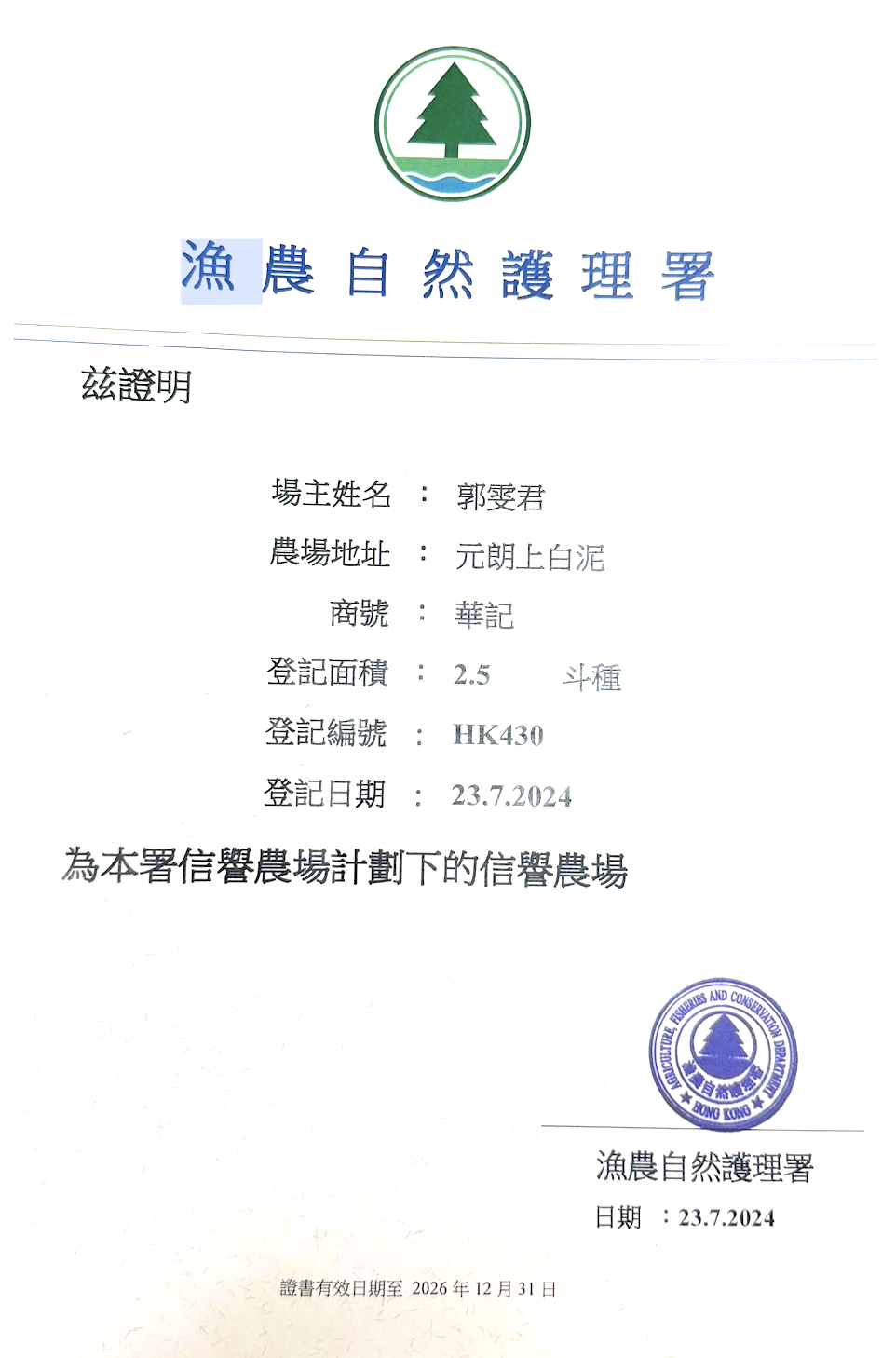
🔖 Certification : Accredited Farm - Accredited Farm Scheme, AFCD*
* AFCD will assess the farm management, horticultural practice, use of pesticides and results of pesticide residue tests before granting accreditation.
🌱 Supplier introduction : Healthy Express is a unique local farm online shopping platform. It cooperates with more than 30 local farms and importers to provide more than 1,500 Products.
Pak Nai is located in the western part of Yuen Long District, Hong Kong, facing Deep Bay and Shekou, Shenzhen. The coastline of Pak Nai consists of mudflats, some of which are oyster farms, producing the famous "Lau Fau Shan oysters." The two main villages are Sheung Pak Nai Village and Ha Pak Nai Village.
Farm Name: Pak Nai Wah Kee Farm
Organic or Conventional Farming? Pesticide-Free Farming
Farm Owner or Farm Introduction: Pak Nai Wah Kee
My grandfather has been farming in Pak Nai since the 1960s. Through the years and changing times, the third generation continues to manage the farm on a small scale.
Registered Credit Farmer: Ms. Kwok MK
登記信譽農場人:郭雯君女士
🛍 Product Information :
Gotu Kola (commonly known as 崩大碗 or 雷公根 in Hong Kong and Guangdong, also called Asiatic Pennywort, Indian Pennywort, Spadeleaf, or Moneywort), scientifically named Centella asiatica, is a perennial creeping herbaceous plant in the Apiaceae (Umbelliferae) family. Native to tropical and subtropical Asia (such as India and Sri Lanka), it is now widely distributed in southern China, Hong Kong, Taiwan, Southeast Asia, and other warm, humid regions. It thrives in moist areas like field edges, ditches, and wetlands, often growing as a ground cover with long, slender stems (sometimes purplish) that root at the nodes.
The leaves are alternate, kidney-shaped or nearly round (2.5–5 cm diameter), with a deep heart-shaped notch at the base and blunt-toothed or shallowly lobed margins—resembling a "broken bowl," which gives rise to the Chinese name "崩大碗" (collapsed big bowl). Tiny flowers are pale purple-red or white, clustered in the leaf axils; fruits are small and flattened.
The whole plant (leaves, stems, and sometimes roots) is edible and medicinal, with a strong grassy flavor that is not bitter. It is popularly used to make cooling herbal tea, soups, juices, or eaten raw when tender. In traditional Chinese medicine, it is considered sweet-bitter-pungent in taste and cooling in nature, entering the liver, spleen, and kidney meridians. It is valued for clearing heat and promoting diuresis, detoxifying, reducing swelling, cooling blood to stop bleeding, invigorating blood circulation, and generating fluids. It has been traditionally used for damp-heat conditions such as jaundice, summer diarrhea, dysentery, sore throat, heatstroke, skin sores, traumatic injuries, external bleeding, and edema. Modern studies highlight its triterpenoids (like asiaticoside), which offer anti-inflammatory, antioxidant, wound-healing, and mild sedative effects. It is also a common ingredient in skincare for soothing sensitive skin and promoting repair.
In Hong Kong, it is a classic summer cooling tea or added to pork rib/intestinal soups. Precaution: Its cooling nature makes it unsuitable in large amounts for those with weak digestion, cold constitution, young children, pregnant or breastfeeding women. Overconsumption may cause gastrointestinal discomfort in some people. Always source from clean areas, distinguish from similar plants, start with small amounts, and consult a healthcare professional or TCM practitioner before regular use, especially if you have underlying conditions.
全草(包括葉、莖,有時連根)均可食用及藥用,味道帶濃烈青草味(不苦),口感清新。民間常用來煲涼茶、煮湯、榨汁或生食嫩葉。中醫認為其味甘、苦、辛,性寒,歸肝、脾、腎經,具有清熱利濕、解毒消腫、涼血止血、活血生津、清熱解毒等功效。傳統上用於輔助改善濕熱黃疸、暑瀉、痢疾、咽喉腫痛、中暑、皮膚瘡毒、跌打損傷、外傷出血、水腫、小便不利等,也被視為消暑解毒的夏日良藥。現代研究顯示其含三萜類化合物(如積雪草苷),有抗炎、抗氧化、促進傷口癒合、鎮靜等作用,在護膚品中常用於舒緩敏感、修復肌膚。
香港傳統常見街頭涼茶或與粉腸、瘦肉煲老火湯。注意:性偏寒涼,脾胃虛寒、體質虛弱者、小孩、孕婦及哺乳期婦女應避免或少量食用(有傳聞過量可能影響妊娠,但主要因寒涼性)。部分人大量服用可能出現腸胃不適、反胃或罕見血液指標變化,建議從小量開始,並咨詢醫生或中醫師。採集野外時需確保無污染,並與相似植物(如銅錢草)區分。
🥘 Recipe:
🔅Notes:
(The above information is a compilation of common Chinese medicine dietary therapies, folk remedies, nutritional information, and traditional dietary knowledge. Actual effects may vary from person to person. It is recommended to focus on a balanced diet and consult a doctor or Chinese medicine practitioner when necessary.)