Description
🚚 The fastest delivery time : 2-day delivery.
🐝 Supplier / Origin : Chile
🔖 Certification : ---
🛍 Product Information :
Forest Fruit Mix (Frozen) is a convenient and nutritious blend of various berries, typically quick-frozen (IQF) at peak ripeness to preserve freshness, flavor, color, and nutrients. This popular frozen fruit mix often includes a combination of classic forest berries such as strawberries, raspberries, blackberries, blueberries, redcurrants, and blackcurrants (the exact composition may vary slightly by brand or supplier).
It offers a perfect balance of sweet and tart flavors, making it ideal for smoothies, desserts, yogurt toppings, baking (e.g., pies, crumbles), sauces, or even enjoyed on its own after thawing. Packed with vitamins (especially vitamin C), antioxidants, fiber, and natural goodness, it's a healthy, year-round alternative to fresh berries.
Storage temperature: -18°C
Do not refreeze thawed product.
These frozen strawberries burst with natural sweetness and a rich summer aroma. Perfect for milkshakes, jams, or baked treats, they bring a vibrant, fruity flavour to your kitchen all year round.
Nutrition
Blueberries are considered a “superfood” because they have such a high concentration of nutrients and are high in antioxidants, which protect us from damage by free radicals. Blueberries are naturally fat free and just have 42 calories per cup. While low in calories, blueberries are a good source of fiber and an excellent source of vitamin C, providing 16% of the recommended daily allowance.
Origin: Peru
In the 21st century, the industry grew in Peru: "Argentine blueberry production has increased over the last three years with planted area up to 400 percent," according to a 2005 report by the U.S. Department of Agriculture.
Nutritional value: Blueberries are extremely rich in flavonoids and polysaccharide compounds, nourishing the liver and kidneys, nourishing blood and improving eyesight.
Blueberries aren't particularly nutrient-dense (the hallmark of a superfood), but they contain three essential nutrients: vitamin C, vitamin K, and manganese.
Nutrients
Blueberries consist of 14% carbohydrates, 0.7% protein, 0.3% fat and 84% water (table). They contain only negligible amounts of micronutrients, with moderate levels (relative to respective Daily Values) (DV) of the essential dietary mineral manganese, vitamin C, vitamin K and dietary fiber (table). Generally, nutrient contents of blueberries are a low percentage of the DV (table). A 100 gram serving provides a relatively low caloric value of 57 kcal with a glycemic load of 6.
Phytochemicals and research
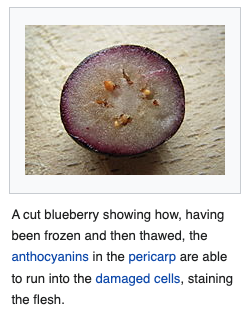
Blueberries contain anthocyanins, other polyphenols and various phytochemicals under preliminary research for their potential biological effects. Most polyphenol studies have been conducted using the highbush cultivar of blueberries (V. corymbosum), while content of polyphenols and anthocyanins in lowbush (wild) blueberries (V. angustifolium) exceeds values found in highbush cultivars.

Because blueberries are rich in anthocyanins, anthocyanins have the effect of activating the retina, which can strengthen vision and prevent eye fatigue. It is also one of the top five healthy fruits recommended by the World Food and Agriculture Organization. And according to the research of scientists in the United States, Japan and Europe, regular consumption of blueberry products can significantly enhance eyesight and eliminate eye fatigue. Medical clinical reports also show that anthocyanins in blueberries can promote the regeneration of rhodopsin in retinal cells, prevent myopia and improve vision.
#Most polyphenol studies were conducted using highbush blueberry varieties (V. corymbosum), while lowbush (wild) blueberries (V. angustifolium) contained polyphenols and anthocyanins that exceeded the values in highbush varieties. Dwarf bush varieties are V. angustifolium, V. boreale, V. mytilloides, V. pallidum and V. angustifolium × V. corymbosum. They are still grown in a similar way to pre-Columbian semi-wild cultivation, slash and burn. Highbush varieties are darrowii and corymbosum. Rabbiteye ( V. ashei / V. virgatum ) is considered distinct from tall and low shrubs. However, the current commercial wild blueberry claims may not be consistent with the fact that the average wild blueberry is actually a blueberry grown in the highlands.
Blueberries contain anthocyanins, other polyphenols and various phytochemicals whose potential biological effects are under preliminary research.
Cooking method:
Blueberries can be eaten right away, soaked in fruit tea, added to salad, used for curing meat or cooking (making jam and desserts).
Special matters:
- Blueberries contain high sugar content, so people with diabetes should be cautious about eating them. It is recommended to use our recommended environmentally friendly vegetable and fruit cleaner Dish Drops to soak for 3 to 5 minutes to eliminate residual pesticides.
- DDT began to be used in blueberry soon after its discovery in 1939, and a few years later in the mid-1940s research began into its use in North America.
- Because "wild" is a marketing term generally used for all low-bush blueberries, it is not an indication that such blueberries are free from pesticides.
Harvest Season:
April to June (North Hemisphere)
June to March (South Hemisphere)
Why choose naturally ripened bananas and fruits
Ripening agents are an indispensable link in the banana industry chain and are widely used all over the world. Because ripe bananas are soft and fragile, green fruits are picked in actual production for sale after long-distance transportation.
Green bananas are "ripened" before being sold. Currently, ethylene is usually produced using a liquid called "Ethefon" to ripen bananas. Ethylene is one of the five natural hormones ubiquitous in plants. Ethephon is a synthetic plant growth regulator. The principle of ripening is the same as that of natural ethylene. However, ethephon is widely used as an insecticide worldwide. Therefore, no matter whether it is safe or not, before bananas are sold in supermarkets, the fruits have the opportunity to be soaked in ripening agents. Consumers lack the right to know. Although bananas do not need to eat the skin, they really need to go through the washing process before they are safe to eat.
這層果粉不是農藥 藍莓上面的一層白色膜
A white powder (bloom) on the top of the blueberry - but it is not a pesticide
https://healthyexpress.blog/2022/12/03/這層果粉不是農藥-藍莓上面的一層白色膜/
In Switzerland, the MRL for blueberries is relatively high at 5 mg/kg. In January 2011, Spanish peppers were recalled from German supermarkets due to levels of ethephon well above the limit. In July 2014, Switzerland banned the use of tomatoes in tomato cultivation after excessive residues were found in Swiss tomatoes during routine cultivation the previous year.
However, in the American Journal of Medicine, a study noted that ethephon, an organophosphorus, has potential hepatotoxic effects. In experimental rats, a significant decrease in body weight was found. The orderly arrangement of liver cells is disrupted and replaced by blood-filled sine waves. At the site, hepatocytes appeared to be degenerated. Scientists report that regular consumption of artificially ripened fruit may lead to dizziness, weakness, skin ulcers, and heart- and liver-related diseases.
References:
Does ethephon have potential hepatotoxic effects? (January-February 2018)
https://www.ncbi.nlm.nih.gov/pmc/articles/PMC5958565/