Description
🚚 The fastest delivery : 2-day.
🐝 Supplier / Origin : Pak Nai Wah Kee, Yuen Long
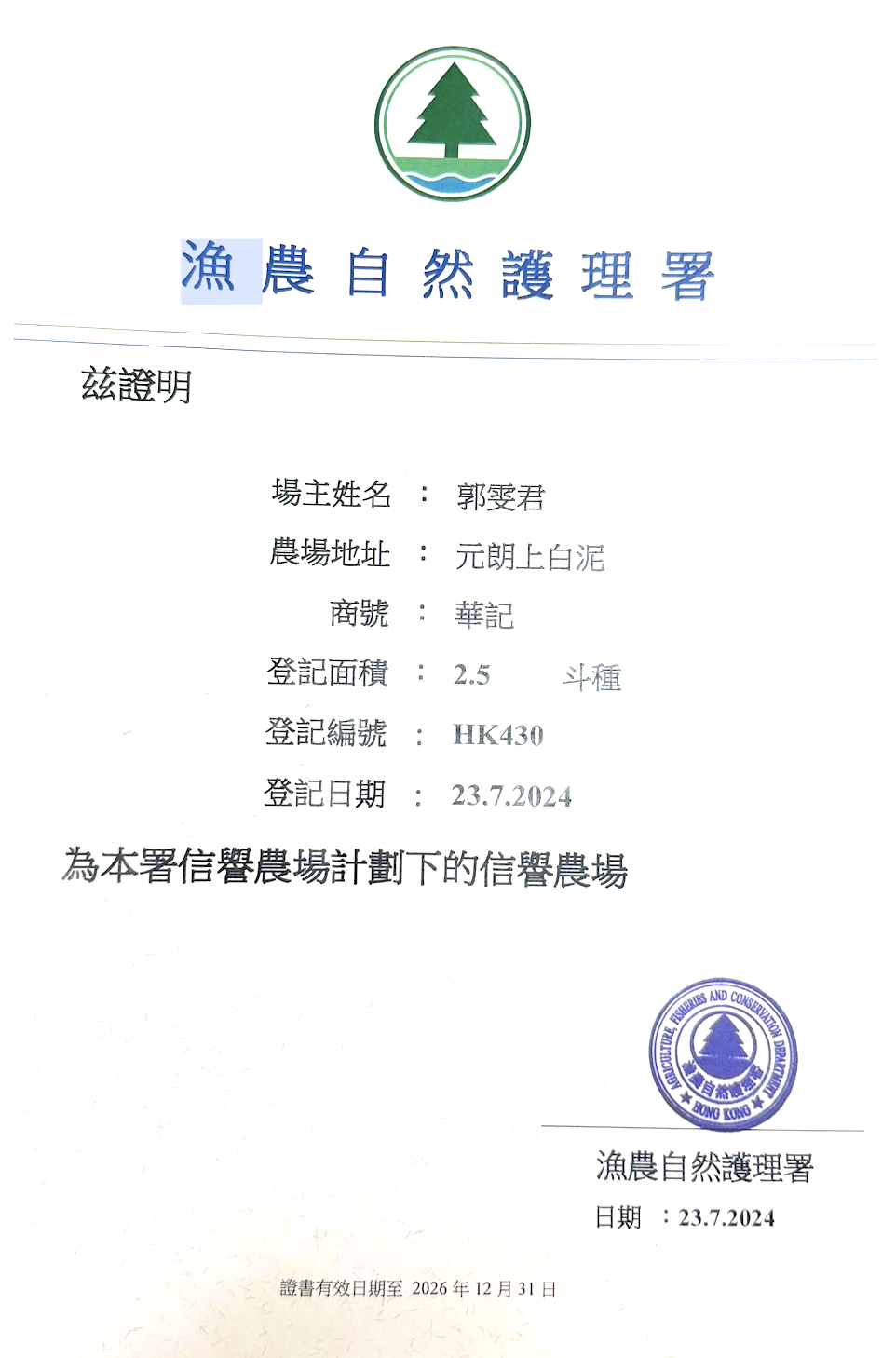
🔖 Certification : Accredited Farm - Accredited Farm Scheme, AFCD*
* AFCD will assess the farm management, horticultural practice, use of pesticides and results of pesticide residue tests before granting accreditation.
🌱 Supplier introduction : Healthy Express is a unique local farm online shopping platform. It cooperates with more than 30 local farms and importers to provide more than 1,500 Products.
Pak Nai is located in the western part of Yuen Long District, Hong Kong, facing Deep Bay and Shekou, Shenzhen. The coastline of Pak Nai consists of mudflats, some of which are oyster farms, producing the famous "Lau Fau Shan oysters." The two main villages are Sheung Pak Nai Village and Ha Pak Nai Village.
Farm Name: Pak Nai Wah Kee Farm
Organic or Conventional Farming? Pesticide-Free Farming
Farm Owner or Farm Introduction: Pak Nai Wah Kee
My grandfather has been farming in Pak Nai since the 1960s. Through the years and changing times, the third generation continues to manage the farm on a small scale.
Registered Credit Farmer: Ms. Kwok MK
登記信譽農場人:郭雯君女士
🛍 Product Information :
Taro (commonly known as 芋頭 in Hong Kong, Guangdong, and Taiwan; smaller varieties sometimes called Eddo or Eddoe), scientifically named Colocasia esculenta, is a tropical perennial herbaceous plant in the Araceae family. Native to Southeast Asia and India, it is now widely cultivated in tropical and subtropical regions worldwide, including southern China, Hong Kong, Taiwan, and many Pacific islands, where it serves as an important staple food.
The edible part is the underground corm (tuber), which is round or oval with rough, ringed skin and white, purple, or mottled flesh. When cooked, it has a starchy, nutty, and slightly sweet flavor with a powdery or creamy texture, similar to potato or yam but distinct.
Taro is nutrient-dense, providing carbohydrates, dietary fiber, potassium, magnesium, vitamins B6 and E, and antioxidants. In traditional Chinese medicine, it is considered sweet-pungent in taste and neutral (slightly warm) in nature, entering the spleen and stomach meridians. It is valued for tonifying the middle burner and qi, strengthening the spleen and stomach, reducing swelling and dissipating nodules, and promoting bowel movement. It is traditionally used to help with spleen deficiency, poor appetite, fatigue, indigestion, and certain swellings (sometimes applied externally).
In Cantonese cuisine, taro is popular in dishes like Taro Braised with Pork (芋頭扣肉), Taro Cake (芋頭糕, a dim sum favorite), taro dumplings, taro paste dessert, and sweet soups. The famous Lipu taro from Guangxi is especially fragrant and powdery.
🥘 Recipe:
🔅Notes:
Precaution: Raw taro contains calcium oxalate crystals that can irritate the throat and skin—always cook thoroughly (steam, boil, or stir-fry). Wear gloves when handling if sensitive. Consume in moderation if you have diabetes due to its starch content or if you have weak digestion.
(The above information is a compilation of common Chinese medicine dietary therapies, folk remedies, nutritional information, and traditional dietary knowledge. Actual effects may vary from person to person. It is recommended to focus on a balanced diet and consult a doctor or Chinese medicine practitioner when necessary.)