Description
🚚 The fastest delivery : 2-day.
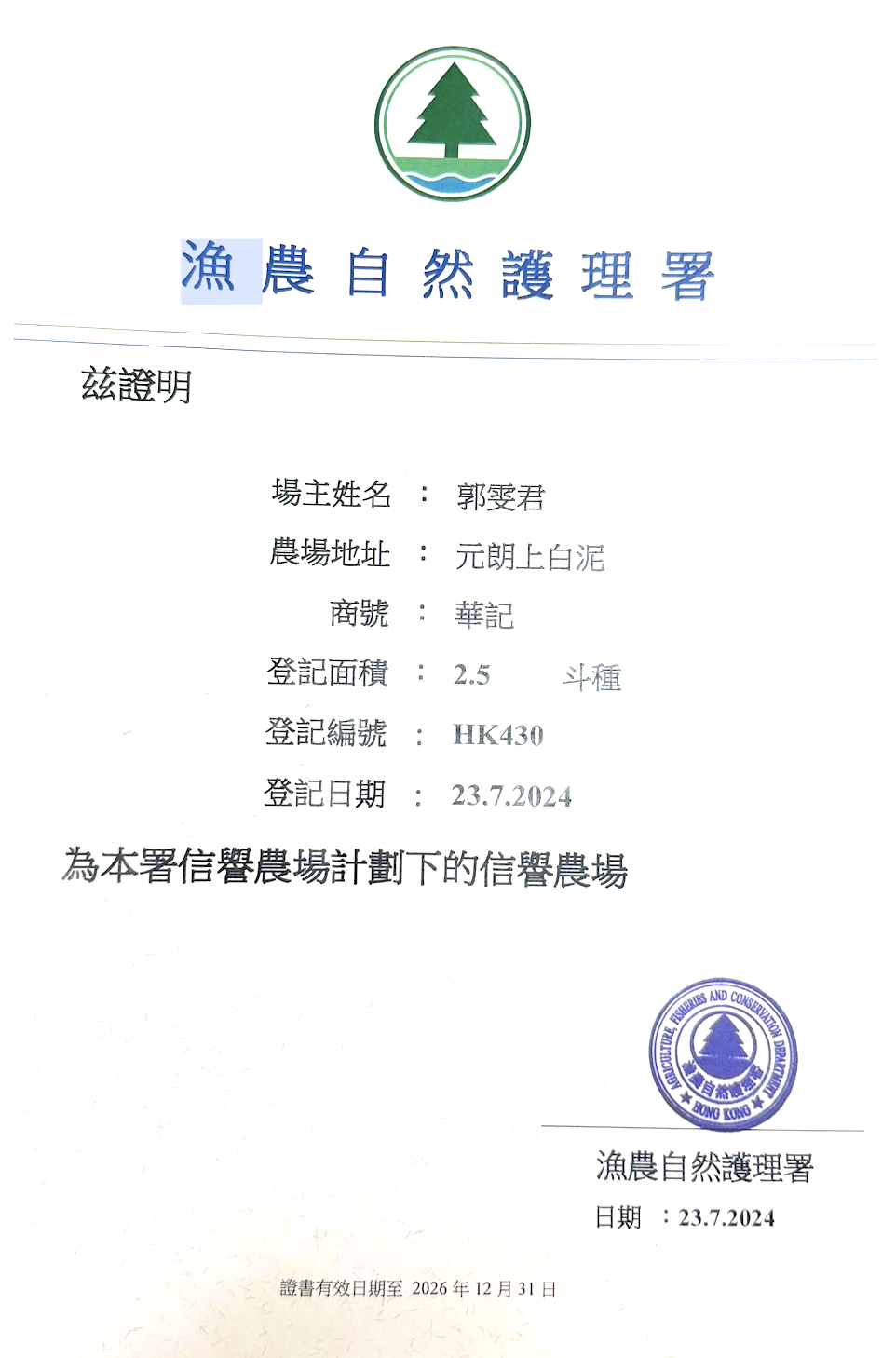
🐝 Supplier / Origin : Pak Nai Wah Kee, Yuen Long
🔖 Certification : Accredited Farm - Accredited Farm Scheme, AFCD*
* AFCD will assess the farm management, horticultural practice, use of pesticides and results of pesticide residue tests before granting accreditation.
🌱 Supplier introduction : Healthy Express is a unique local farm online shopping platform. It cooperates with more than 30 local farms and importers to provide more than 1,500 Products.
Pak Nai is located in the western part of Yuen Long District, Hong Kong, facing Deep Bay and Shekou, Shenzhen. The coastline of Pak Nai consists of mudflats, some of which are oyster farms, producing the famous "Lau Fau Shan oysters." The two main villages are Sheung Pak Nai Village and Ha Pak Nai Village.
Farm Name: Pak Nai Wah Kee Farm
Organic or Conventional Farming? Pesticide-Free Farming
Farm Owner or Farm Introduction: Pak Nai Wah Kee
My grandfather has been farming in Pak Nai since the 1960s. Through the years and changing times, the third generation continues to manage the farm on a small scale.
Registered Credit Farmer: Ms. Kwok MK
登記信譽農場人:郭雯君女士
🛍 Product Information :
在香港、廣東地區俗稱「紫蘇葉」或「蘇葉」,也叫紅蘇、赤蘇、香蘇;在台灣稱「紫蘇葉」;日本稱「シソ(Shiso)」、韓國稱「깻잎(Kkaennip)」。
Perilla Leaf (commonly known as 紫蘇葉 or 蘇葉 in Hong Kong and Guangdong, also called Shiso Leaf in Japanese cuisine or Korean Perilla / Kkaennip), scientifically named Perilla frutescens, is the aromatic leaf of an annual herbaceous plant in the Lamiaceae (mint family). Native to central-southern China and Southeast Asia, it is now widely cultivated throughout East and Southeast Asia.
The plant has square stems and opposite, ovate leaves with coarsely serrated margins. Leaves may be green or deep purple-red (red perilla), releasing a distinctive fragrant aroma when crushed due to compounds like perillaldehyde. It is rich in vitamins A and C, beta-carotene, anthocyanins, iron, calcium, dietary fiber, and various antioxidant phytochemicals with anti-inflammatory properties.
In traditional Chinese medicine, perilla leaves are considered pungent and warm in nature, entering the lung and spleen meridians. They are valued for releasing the exterior to dispel cold, regulating qi to harmonize the middle burner, promoting digestion, stopping vomiting, calming the fetus, and detoxifying fish and crab poisoning. They are traditionally used for wind-cold colds (with chills, fever, headache, nasal congestion, cough), chest and abdominal distension, pregnancy-related nausea, and seafood-induced gastrointestinal discomfort.
In Cantonese cuisine, perilla leaves are popular for steaming fish or cooking crab to remove fishy odors and toxins. In Japanese cuisine, fresh shiso leaves are used to wrap grilled meats or accompany sashimi. In Korean cuisine, they are often pickled or used to wrap meat.
Precaution: Its warm and dispersing nature makes it unsuitable in large amounts for those with yin deficiency, internal heat, or spontaneous sweating. Pregnant women may use it for nausea under professional guidance. It contains oxalates, so consume moderately if prone to kidney stones. Fresh leaves offer the strongest aroma and are best eaten raw, lightly stir-fried, or steamed; dried leaves are suitable for teas or decoctions.
🥘 Recipe:
🔅Notes:
(The above information is a compilation of common Chinese medicine dietary therapies, folk remedies, nutritional information, and traditional dietary knowledge. Actual effects may vary from person to person. It is recommended to focus on a balanced diet and consult a doctor or Chinese medicine practitioner when necessary.)