Description
🚚 The fastest delivery : 2-day.
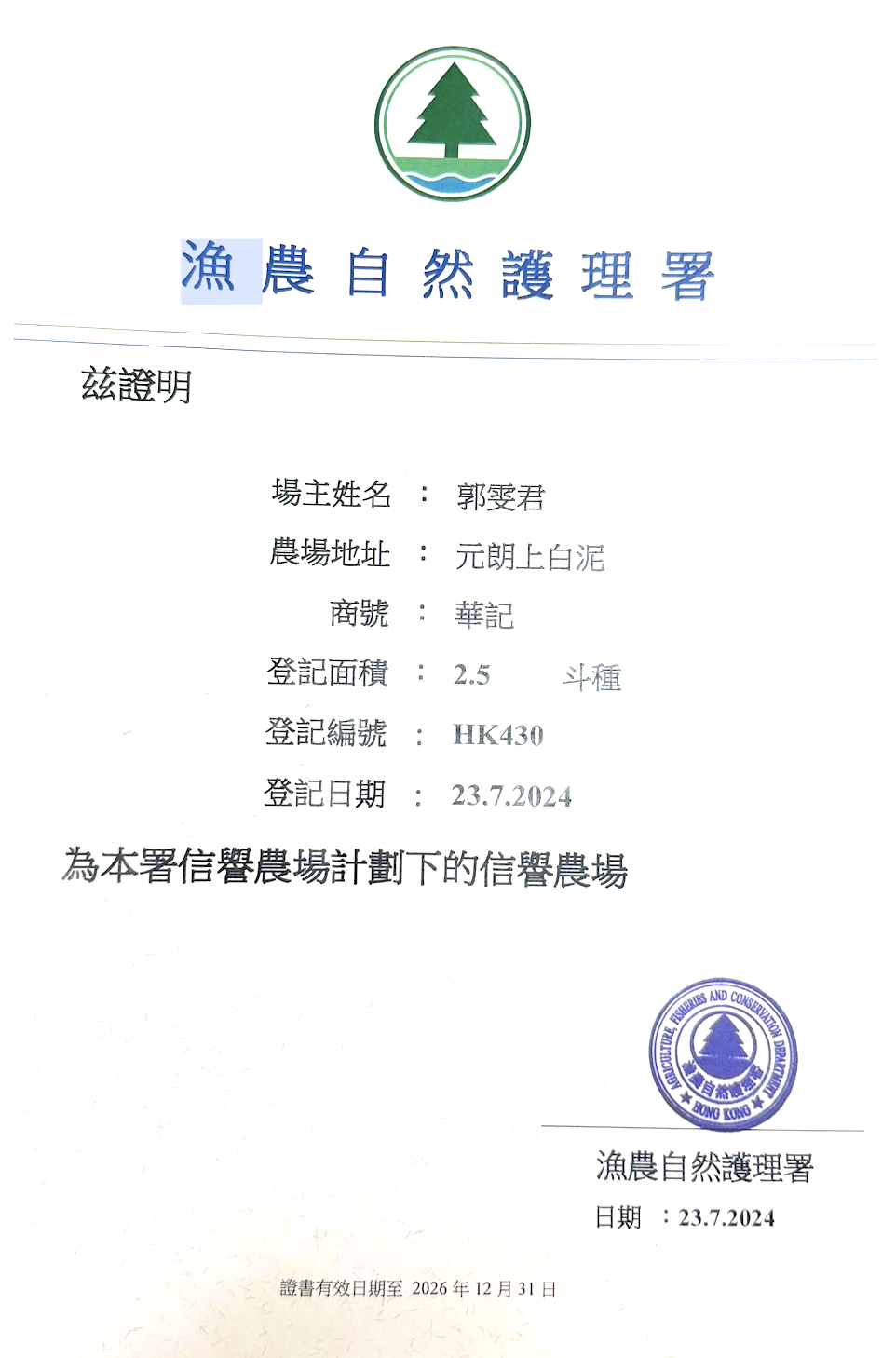
🐝 Supplier / Origin : Pak Nai Wah Kee, Yuen Long
🔖 Certification : Accredited Farm - Accredited Farm Scheme, AFCD*
* AFCD will assess the farm management, horticultural practice, use of pesticides and results of pesticide residue tests before granting accreditation.
🌱 Supplier introduction : Healthy Express is a unique local farm online shopping platform. It cooperates with more than 30 local farms and importers to provide more than 1,500 Products.
Pak Nai is located in the western part of Yuen Long District, Hong Kong, facing Deep Bay and Shekou, Shenzhen. The coastline of Pak Nai consists of mudflats, some of which are oyster farms, producing the famous "Lau Fau Shan oysters." The two main villages are Sheung Pak Nai Village and Ha Pak Nai Village.
Farm Name: Pak Nai Wah Kee Farm
Organic or Conventional Farming? Pesticide-Free Farming
Farm Owner or Farm Introduction: Pak Nai Wah Kee
My grandfather has been farming in Pak Nai since the 1960s. Through the years and changing times, the third generation continues to manage the farm on a small scale.
Registered Credit Farmer: Ms. Kwok MK
登記信譽農場人:郭雯君女士
🛍 Product Information :
Chinese Mugwort (commonly known as 艾草 or 艾葉 in Hong Kong, Guangdong, and Taiwan, also called Asiatic Wormwood or simply Mugwort), scientifically named Artemisia argyi, is a perennial herbaceous plant in the Asteraceae (Compositae) family. Native to East Asia (eastern China, Korean Peninsula, Japan), it is now widely distributed in Asia and Europe. The plant has a strong, distinctive aromatic scent due to volatile oils (such as 1,8-cineole).
Leaves are thick and papery, often covered with grayish-white hairs, deeply lobed or pinnatifid. Tender leaves are softer; mature leaves are dried and processed into moxa (艾絨) for moxibustion. Flower heads are small and yellowish-green.
It is rich in volatile oils, flavonoids, minerals, vitamins A, B-complex, C, and dietary fiber. In traditional Chinese medicine (TCM), it is considered pungent-bitter in taste and warm in nature, entering the spleen, liver, and kidney meridians. It is valued for warming the meridians to dispel cold, stopping bleeding and regulating menstruation, removing dampness to relieve pain, calming the fetus, and regulating qi and blood. It is traditionally used for menstrual disorders, dysmenorrhea, uterine bleeding, threatened miscarriage, wind-cold colds, abdominal pain, rheumatic conditions, and certain skin issues.
In Cantonese and Hong Kong folk practice, tender leaves may be used in egg soups or stir-fries (e.g., in eastern Guangdong); dried leaves are added to soups (such as chicken soup with longan, goji, and codonopsis), steamed chicken (Hakka style), or made into teas. Moxa is widely used in moxibustion therapy to warm channels, dispel cold, and relieve pain. It also has traditional uses as a mosquito repellent, air purifier, and antimicrobial agent. During Dragon Boat Festival, mugwort is hung for warding off evil.
Precaution: Its warming nature makes it unsuitable in large amounts for those with yin deficiency, internal heat, or blood-heat conditions. Pregnant women should use only under professional guidance (may cause uterine contractions if overused). Excessive or prolonged use may affect the liver or nervous system. Ensure good ventilation during moxibustion; avoid use when overtired, overfull, or febrile. External use may cause photosensitivity reactions.
🥘 Recipe:
In Hong Kong and Guangdong, mugwort is used in various folk practices: tender leaves can be added to egg drop soup or cooked in dishes (Dongjiang River basin, Guangdong, Dongjiang cuisine); dried mugwort leaves are often used in soups (such as mugwort stewed chicken with longan pulp, goji berries, and codonopsis), steamed chicken (Hakka style), or made into mugwort tea. Mugwort floss is used in moxibustion therapy (to warm and unblock meridians, dispel cold, and relieve pain). In addition, mugwort has folk uses such as repelling mosquitoes, deodorizing, and antibacterial properties, and it is often hung during the Dragon Boat Festival to ward off evil spirits.
香港及廣東民間用法多樣:嫩葉可打蛋湯或煮菜(廣東東江流域、東江菜);乾艾葉常用於煲湯(如艾葉燉雞、加桂圓肉、枸杞、黨參)、蒸雞(客家風味)、或製成艾葉茶。艾絨則用於艾灸療法(溫通經絡、祛寒止痛)。此外,艾草有驅蚊、除臭、抗菌等民間用途,端午節常掛艾草辟邪。
🔅Notes:
注意:性溫偏熱,陰虛火旺、燥熱體質、血熱出血者不宜過量;孕婦使用需醫師指導(雖有安胎作用,但過量可能引起子宮收縮);過量或長期使用可能損肝或引起神經不適。艾灸時注意通風,避免過勞、過飽或發燒時使用。外用可能引起光敏反應(接觸後曝曬易皮膚不適)。新鮮嫩葉適合少量食用,老葉或乾品多作藥用。
(The above information is a compilation of common Chinese medicine dietary therapies, folk remedies, nutritional information, and traditional dietary knowledge. Actual effects may vary from person to person. It is recommended to focus on a balanced diet and consult a doctor or Chinese medicine practitioner when necessary.)