SPF is the abbreviation of specified-pathogenfree. That means that SPF-flocks for the production of SPF-eggs are free from specific undesirable microorganisms.

Table 1
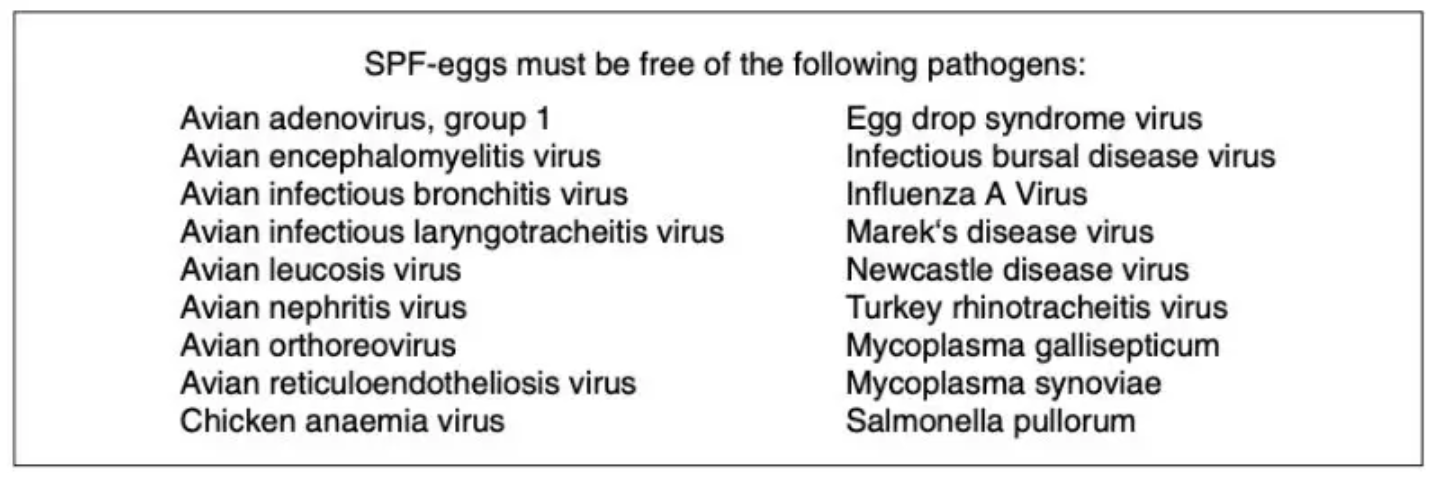
The antigens not accepted under SPF conditions as defined in the European Pharmacopoeia (Ph. Eur.), 6th edition are shown in Table 1.
SPF Eggs
A Specified Pathogen Free (SPF) Embryo is the starting biotechnology product for a number of downstream virology and diagnostic products and procedures; human and veterinary vaccines and diagnostic reagents , research and pharmaceutical products. We are in long time facing the demand-supply gap in India and surrounding countries and the risk of interruption of supply of SPF eggs.
What are Specific Pathogen Free Eggs
Specific Pathogen Free (SPF) Eggs are fertile chicken eggs produced from known SPF parent flocks established and maintained as per the recommendations of a committee appointed in 1974 by the International Association of Biological Standardization (IABS) Geneva, under the Chairmanship of Dr. R. Luginbhul, the father of SPF technology.
SPF eggs do not contain vertically transmitted pathogens, namely Avian Adenovirus, Avian encephalomyelitis virus, Reo viruses, Lymphoid luekosis, Reticulo endotheliosis, Mycoplasma gallispticum, Mycoplasma synoviae, Salmonella Pullorum and other vertically transmitted pathogens. In addition, SPF eggs are not affected by horizontally transmitted infections such as Newcastle disease virus, infectious bronchitis, infectious bursal disease, Marek's disease and avian influenza.
The Importance of SPF Eggs in Vaccine Production and Testing
The main application areas of SPF embryonated eggs are in the production and control of human and animal vaccines. Control or testing of vaccines The “substrate” used for vaccine control (starting materials, process controls and final product testing) is the same as for virus production: embryonated eggs, primary cell cultures derived from embryonated SPF eggs and SPF chickens.
For testing purposes, it is inevitable to use SPF eggs to avoid falsification of test results due to contamination with other antigens. Maintaining the equipment required for hatching eggs (e.g. incubators), logistics regarding delivery/transportation quality, pre-hatching conditions, etc. requires specialized knowledge and manpower. Additionally, individual differences in eggs (shape, air cells, size) present additional obstacles to reproducible and robust testing. SPF embryonated eggs are mainly used for live virus titration and foreign material detection. In rare cases, serum neutralization tests are performed in eggs.
Testing in primary cells (Chick embryo fibroblasts, CEF or chicken embryo kidney cells, CEN) is similar to the virus production process. Special attention should be paid to possible cell contamination during embryo extraction. Validation of tests performed in cells follows the principles of in vitro testing. Primary cells derived from SPF embryonated eggs are commonly used for viral titration, foreign material testing, and serum neutralization testing. Testing of vaccine quality, safety and effectiveness requires testing on chickens. For quality purposes, chickens are used to detect foreign substances. There are major efforts underway to replace these tests with in vitro tests. SPF chicken is primarily used for laboratory testing of safety and efficacy. Safety and efficacy trials are particularly unavoidable in order to determine how a vaccine will behave in target animals. Regarding the validation and organization of the tests, the aspects already mentioned regarding the production and use of eggs apply. For safety testing, many tests must be performed (overdose studies, vaccine strain spread, virulence recovery, etc.). Efficacy testing includes serology and challenge tests to determine the onset, level, and duration of immunity.
In conclusion
SPF embryonated eggs are essential for the production and control of vaccines suitable for eggs. SPF eggs are also a great source of primary cells and even live chickens. No biological matrix can replace SPF eggs. Even though the personnel, logistics, and equipment resources required to use eggs are demanding, the benefits of safe production and testing outweigh the overall cost of using this point-of-care system.
References
- European Pharmacopoeia (Ph. Eur.), 01/2008: 50202, 6th edition, Council of Europe, Strasbourg, France, 2008.
- Amending Directive 2001/82/EC on Community regulations relating to veterinary medicinal products (OJ No L 136 of 30 April 2004, page 58).
- The Importance of SPF-Eggs in Manufacturing and Testing of Poultry Vaccines,Dr. Andreas Motitschke & Dr. Carmen Jungbäck
- Immunology The Experimenter Series, Werner Luttmann, 2007


