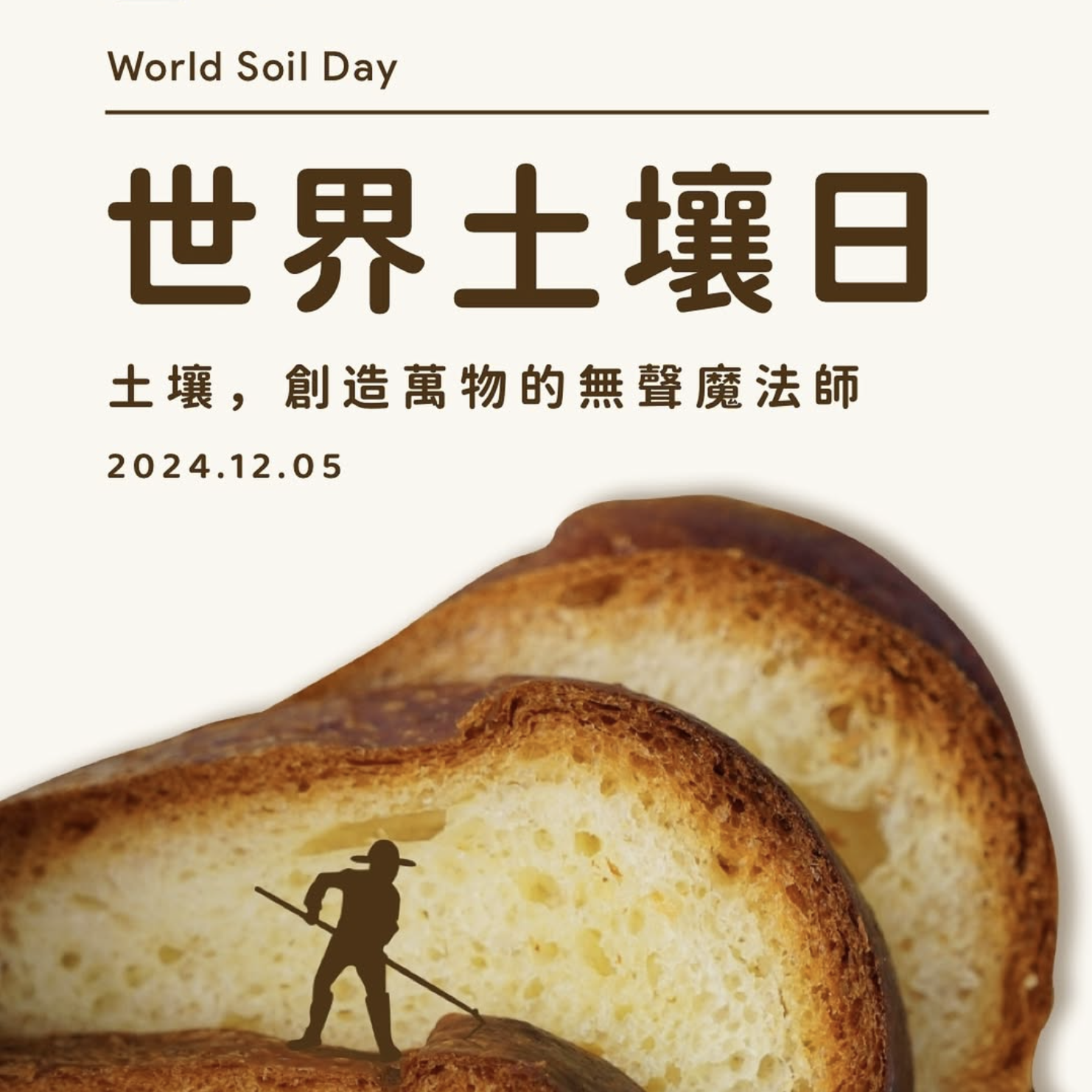
December 5th of every year is World Soil Day (世界土壤日).
The soil gives birth to all things. The "Tao Te Ching" 《道德經》(老子 (書) records that "Heaven and earth are not benevolent, all things are like straw dogs" (天地不仁,萬物為芻狗) The "Tao Te Ching" tells us that the Tao is invisible, heartless, and nameless, but it can give birth to heaven and earth, run the sun and the moon, and nourish all things. In short, the world is fair, selfless, non-discriminatory, without likes or dislikes, and without favoritism, and it continues to operate.
"Unkindness" (不仁) means "treating everyone equally" (一視同仁), which emphasizes the Taoist way of natural inaction and is not bound by the Confucian (儒家) emphasis on ethical "benevolence" (仁). All things are allowed to change and develop according to the natural laws between heaven and earth, without the need for any "master" who is above the laws of nature to command and arrange them. This is how life between heaven and earth continues forever.
However, most of our farmers simply believe that as long as the soil is softer, has more organic matter, has more earthworms, has good intentions, and does not use chemical fertilizers and pesticides... the soil will be healthy and the crops will be delicious. However, to carry out farming work, one needs to have a lot of professional and even scientific knowledge related to agriculture, and be able to make continuous and timely adjustments. Everything in the farmland, whether audible or silent, living or nonliving, visible or invisible, is a mentor to farmers. Even every loss or disease infestation is a mentor. In the past, the buffering capacity and resilience of the land were relatively ideal and strong, so people have inadvertently ignored the role of mentors; in modern times, the buffering capacity and resilience of the land are no longer what they used to be, and it is worth spending time studying soil cultivation, especially for those who care about the soil.
If humans only emphasize the use of various "friendly" and "organic" methods, because I want to do good things, have a good heart, use powerful materials and tools... and expect to create a "beautiful environment" in this way, they often deviate from the seemingly negative path of "learning from nature" and even move towards the delusion of "man can conquer nature".
The concept of "good soil" (好土) includes increasing soil organic matter, the presence of earthworms, looseness, and chemical fertilizers causing soil salinization and acidification... In fact, it is the output of various one-sided views. Nature has always been a complex system with multiple variables that are constantly changing. The weights of various variables, including those that can be revealed by human capabilities and those that have not yet been perceived, are constantly changing. Looking only at the surface, focusing on one or more factors, is not enough to realize the laws of nature.
How does soil work? Taking our daily lives as an example, humans cannot make their lives better by investing resources and energy on their own. Instead, they rely on the operation of different roles and facilities to "transport" "matter and energy" to appropriate locations. Only after a complex corresponding procedure can a "good life" be achieved. For example, we rely on logistics companies to transport food produced by farmers, which is then cooked by chefs to become delicious food, and then absorbed and digested by us to convert it into energy for survival. Before crops can be planted, seeds and seedlings must be produced. We cannot complete all the work in the food production and sales chain by ourselves, but we can benefit from the process of these material conversions and energy flows.
The process by which farmers harvest agricultural products and make profits is essentially about humans taking care of crops and trying to convert and flow materials and energy in the farm environment to support the needs of crops. After the crops grow healthily, the usable parts of the crops are harvested and become commodities. If we do not understand the causes, consequences and overall picture of these processes, various subsequent problems will arise and become more formalistic.

Soil has different textures and colors depending on how often it is tilled, its location and its composition. From upper left to lower right: earthworm castings, lumps of soil next to grass roots, frequently tilled soil, and even more frequently tilled soil.

The state of soil requires observation and analysis in different ways. Immersing the soil in water can reflect the stability of the soil structure. The more turbid the water is, the more unstable the structure is. It is easy for water erosion to cause the movement of particles, resulting in the filling of soil pores or the loss of fertility.
The emergence of chemical fertilizers and the problem of pesticides
Since World War II, humans have used large amounts of chemical pesticides and fertilizers, and have also engaged in large-scale monoculture - that is, planting the same crop repeatedly on the same piece of land. Although this system can dramatically increase production, it also causes many environmental, human health and other problems.
Impact on crops
General fertilizers only provide limited nutrients, mainly nitrogen, phosphorus, potassium and some other elements, but most of them are not comprehensive enough. Moreover, chemical fertilizers are generally formulated to be very easy for plants to absorb. If applied in excess, crops are prone to receiving excessive but unbalanced nutrients, which not only causes the plants to grow taller and become tender, but also attracts more pests (such as aphids) to attack. In addition, monoculture combined with chemical fertilizers will provide a constant supply of food to pests of that crop, allowing them to continue to reproduce. At the same time, in this system, some high-yield varieties that respond well to fertilizers will be selected, while some varieties that are insect-resistant and disease-resistant but have low yields will be abandoned. Therefore, the demand for chemical pesticides for crops will increase.
Impact on the environment
In fertile soil, nutrients are stored in the organic matter and minerals in the mud. They need to be decomposed and released by microorganisms before they can be absorbed by plants. Even in soil that has been fertilized with large amounts of chemical fertilizers, because most fertilizers contain uneven nutrients, plants still need to absorb other nutrients from the soil in order to thrive. With continuous extraction and incomplete replenishment, the soil will become thinner and thinner, and will have to rely on more chemical fertilizers to replenish it, creating a vicious cycle.
On the other hand, fertilizers are just some lifeless chemicals that cannot provide organic matter to the organisms in the soil. Therefore, it will reduce the number of organisms in the soil, turning the soil into a pile of lifeless minerals, reducing the amount of organic matter in the soil and causing it to lose its adhesion. When it rains or is windy, the soil particles on the surface are easily washed away or blown away, making the land gradually unsuitable for planting. About 2 billion hectares of land in the world are experiencing soil degradation, of which 12% is due to nutrient deficiency, salinization, acidification and pollution, 56% is due to water erosion, and 28% is due to wind erosion.
In addition, fertilizers that are not absorbed by plants will be washed into rivers or groundwater. These sudden nutrients will cause algae in the water to multiply rapidly, consume oxygen in the water, and cause other aquatic organisms (such as fish) to suffocate and die.
Before chemical fertilizers were widely used, farmers used animal manure and crop residues as fertilizer. But now, these have almost become waste, and when they are discarded by farmers, they cause environmental pollution. The Hong Kong government has to enact laws to control the discharge of livestock waste. Animal manure is used as fertilizer not only in organic farms but also in ordinary farms. In 1999, 90 million tonnes of animal waste was produced on UK farms, of which only 1% was produced on organic farms. Since organic farms have production standards, the animal manure used in the regulations must be composted until it is fully decomposed, but general farms do not compost the manure completely, so problems are more likely to occur.
Organic Farming
The difference between biological farming and organic farming lies in the understanding of organic matter and organic matter. For a long time, the technical concept, practice and practicality of organic agriculture have been to pile up and compost organic matter and add microorganisms to make so-called fully decomposed organic fertilizer. Excellent organic fertilizer is the concept of fully decomposed organic matter. However, organic fertilizer becomes an extremely low nutrient supply condition. In the process of organic fertilizer stacking, complete decomposition also indicates the loss of basic elements. After the structure of organic protein is decomposed and released, only a small amount of nitrogen, phosphorus and potassium elements remain in the organic fertilizer. After a large amount of nutrients are oxidized, the soil loses the organic matter supplement. Therefore, the use of organic fertilizer cannot create excellent cultivation effects, which makes farmers unable to understand or recognize this, and finally unable to show superior results. The principle of bio-farming is to use fresh organic matter instead of organic matter to put into the soil. However, when fresh organic matter is put into the soil, the roots will be damaged immediately and the soil will not be able to decompose the organic matter, resulting in the breeding of bacteria.
The discussion of natural farming is also a kind of cognition and technology that aims to clearly explain such cause and effect relationships. Returning fresh organic matter to the soil is the basic principle of supplying complete nutrients to the soil, but in practice it results in damage to roots and pathogens. The actual reason is that the soil does not have the ability to mineralize and decompose organic matter, just like our stomach and intestines cannot withstand fresh pork or too much vegetables. It is not that fresh pork and vegetables have no nutrition, but that our stomach and intestines can easily decompose and absorb them after they are cooked.
When the soil is destroyed, water resources are polluted. Because healthy crops cannot be grown using chemical fertilizers, large amounts of pesticides, sterilizers, and insecticides are required, causing air and water pollution. The destroyed soil can grow toxic crops and crops without nutrition, making the human body empty and causing it to lose health without knowing it. This is the root of evil. Destroying the earth's soil is the key to initiating evil causes.
References
This article reproduces and excerpts from Taiwan's Chen Xingzong, a soil expert's perspective on soil reflections


