Produce of Guangdong, China
The proportion of agriculture in Guangdong's economy has gradually decreased over the past 20-30 years, but agriculture still occupies an important position in the local area. Maoming and Zhanjiang in western Guangdong are the first and second largest agricultural cities in Guangdong, and the total agricultural output value of the two cities accounts for a quarter of the province.
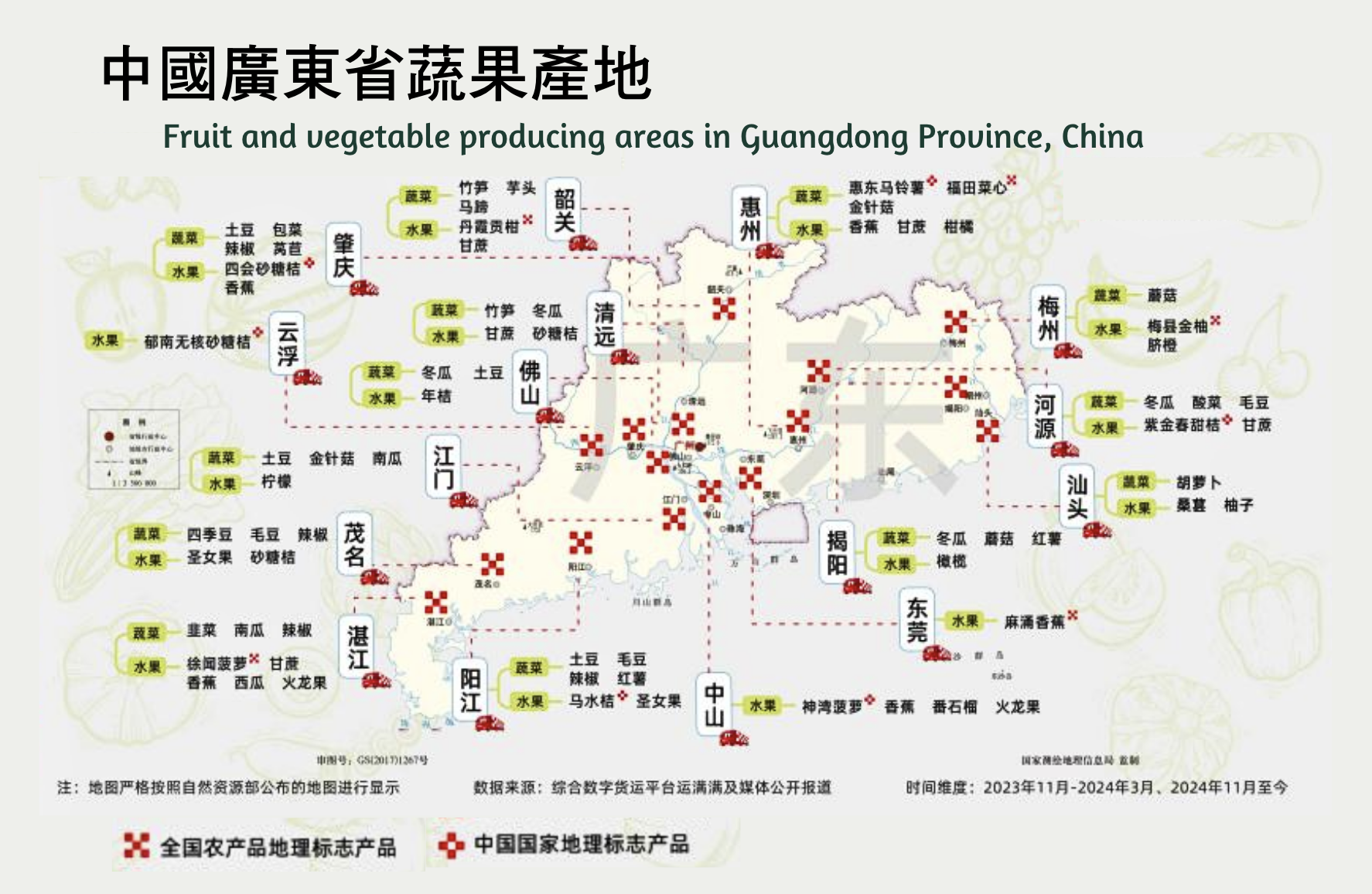
Fruit and vegetable production areas in Guangdong Province, China
Guangdong's agricultural products are represented by fruits and tea. Well-known agricultural products include Guangdong silk rice, Yingde black tea, Chaozhou Phoenix Dancong, Xinhui mandarin oranges, Qingyuan chicken, Maoming lychee, Zhanjiang pineapple, Meizhou pomelo, Wengyuan orchid, Deqing tribute orange, Maoming tilapia, Zhanjiang prawns, Doumen Baijiao sea bass, etc.
.svg)
Location of Guangdong Province
Guangdong is rich in fruit resources and is a famous fruit town in China. There are more than forty or fifty varieties of fruits cultivated as economic crops in Guangdong, mainly citrus, lychee, longan, pomelo, mango, banana, pineapple, etc. In 2004, the province's fruit area was 986,650 hectares and the total output was 7.8785 million tons. In terms of output, Maoming and Zhanjiang, two fruit producing areas, both produce about 2 million tons of fruit annually.
Guangdong's climate is suitable for growing vegetables all year round, with a wide variety of vegetables. It is also the main production area of off-season vegetables in China. The summer and autumn off-season vegetable production base in northern Guangdong, the processed vegetable production base in eastern Guangdong and the export vegetable production base in the Pearl River Delta. The western Guangdong region takes advantage of the warm winter climate and mainly grows off-season vegetables, which is an important part of China's vegetable transportation from the south to the north; the Pearl River Delta region is an export vegetable production base.
The main vegetable varieties in Guangdong include Chinese cabbage, kale, cabbage, rapeseed, lettuce, wax gourd, bitter gourd, cucumber, wax gourd, radish, potato, sweet potato, eggplant, tomato, green bean, cowpea, lotus root, etc. In 2009, the total vegetable planting area in Guangdong Province was 1.138 million hectares, with a total output of 25.6717 million tons. Vegetables are mainly fresh vegetables, with an annual export volume of about 700,000 tons, mainly sold to Hong Kong, Macao, Japan, Southeast Asia and other places, with an output of US$194.26 million.
The main food crops in Guangdong Province are rice, and the main cash crops are sugarcane, cassava, peanuts, fruits, tea, sericulture, etc. The annual grain output is more than 12 million tons, and the output accounts for about 4.7% of the country's vegetables, 6.5% of its fruits, 5.2% of its meat and 13% of its aquatic products. Taking 2009 as an example, the total sown area of crops in Guangdong Province was 67.1406 million mu, of which 38.0775 million mu were grain crops, accounting for 56.71% of the sown area; the total grain output was 13.1450 million tons. Among them, the rice planting area was 29.3955 million mu, accounting for 77.20% of grain crops; the rice output was 10.5810 million tons, accounting for 80.49% of grain output. Rice production in Guangdong has a history of more than 3,000 years and is an important double-season rice producing area in China.
Other major crops are dryland crops such as sweet potatoes and corn. In 2009, the output of sweet potatoes was 1.6243 million tons and the output of corn was 714,900 tons. Sugarcane is a major cash crop in Guangdong, mainly grown on dry land, with the coverage rate of high-quality varieties reaching over 95%. In 2009, the province's sugar cane planting area was 2.2785 million mu, with a total output of 12.5351 million tons. Zhanjiang is the main sugarcane producing area, with a planting area of 1.8038 million mu, accounting for 79.2% of the province; the output is 9.97 million tons, accounting for 79.5% of the province.
Distribution by type:
Zhaoqing is the main citrus production area, with an annual output of more than 740,000 tons in 2009.
Maoming and Zhanjiang are tropical fruit producing areas, with an annual banana output of more than one million tons;
Zhanjiang is the main pineapple producing area, with an annual output of more than 500,000 tons;
Maoming is the main lychee and longan producing area, with an annual lychee output of more than 300,000 tons and an annual longan output of more than 200,000 tons.
The three major cassava producing areas are distributed in Yunfu, Zhanjiang and Zhaoqing. In 2009, the province's cassava output was 1.5537 million tons, of which the total output of the three cities was 892,000 tons, accounting for 57.4% of the province.
Peanut is the main oil crop, with two crops each year in spring and autumn. The province's total sown area of oil crops is 7.45 million mu, with a yield of 846,400 tons; of these, peanuts are 7.24 million mu, with a yield of 836,300 tons.
Tea is a traditional cash crop and export commodity in Guangdong, with Yingde black tea and Chaozhou Phoenix Dancong tea being the most famous. In 2010, the tea output was 52,600 tons.
Distribution by region:
Huizhou's bananas, sugar cane, citrus fruits, potatoes, enoki mushrooms and Chinese cabbage are the vegetable products with the largest output in Huizhou. Huidong potatoes from Huidong County, Huizhou City are Chinese national geographical indication products, and Futian Chinese cabbage from Boluo County, Huizhou City is a national agricultural product with geographical indication products.
Zhanjiang is an important base for transporting vegetables from the south to the north, including pineapples, sugar cane, bananas, watermelons, dragon fruits and other fruits. Among them, the Xuwen pineapple from Xuwen County is a national agricultural product with geographical indication, and its pineapple production accounts for one-third of the country's total. Zhanjiang City is the main sugarcane producing area in Guangdong, accounting for one-tenth of the country's sugarcane production. The pitaya from Suixi County, Zhanjiang City is a pillar industry of local agriculture. Vegetables such as leeks, pumpkins, and peppers are transported in large quantities locally.
Zhaoqing’s fruits include mandarin oranges, bananas, and vegetables include potatoes, cabbage, peppers, and lettuce. Among them, the Sihui mandarin oranges from Sihui City, Zhaoqing City are national geographical indication agricultural products.
Heyuan's sugarcane, oranges and other fruits; Heyuan's winter melon, sauerkraut, edamame, etc. Among them, the Zijinchun sweet orange from Zijin County, Heyuan City is one of the county's main industries and is also a Chinese national geographical indication product.
Meizhou's mushrooms, golden pomelo, and navel oranges, among which the Meixian Golden Pomelo from Meixian District of Meizhou City is a national agricultural product with geographical indications, and Pingyuan County is known as the only "navel orange hometown" in Guangdong Province.
Shaoguan's tribute oranges, sugarcane, bamboo shoots, taro, water chestnuts and other fruits. Among them, the Danxia tribute oranges from Renhua County, Shaoguan City are national agricultural products with geographical indications. Renhua is also the largest tribute orange producing area in the country. Among them, Lechang North Township in Shaoguan City is known as the "Hometown of Chinese Horseshoes".
Yangjiang’s Ma Shui oranges, cherry tomatoes and other fruits, among which Ma Shui oranges are a national geographical indication product of China. Yangjiang has a large transportation volume of vegetables such as potatoes, edamame, peppers, and sweet potatoes.
Yunfu's tangerines and the Yunan seedless tangerines from Yunfu City's Yunan County are China's national geographical indication products.
Bananas from Dongguan; oranges, wax gourds and potatoes from Foshan; lemons, potatoes, enoki mushrooms and pumpkins from Jiangmen; olives, wax gourds, mushrooms and sweet potatoes from Jieyang; cherry tomatoes, tangerines, green beans, edamame and peppers from Maoming; fruit dragon fruits, tangerines, fruit mao, fruit mao's nut fish and fruit-filled mulberries.
References:
Wikipedia - Guangdong Province Economy#Agriculture


