Food allergy is one of those conditions that often causes anxiety for patients and their caregivers, especially when it is life-threatening. We eat several times a day, but patients need to worry about the safety of every bite of food, which seriously affects their mental health.
What is food allergy?
Food allergy is a reaction of the body's immune system to some substances in food. A very low level of an allergenic substance may cause an allergic reaction in susceptible populations. A local survey revealed that about 1 out of 20 children in Hong Kong was reported to have food allergies.
Common allergens are:
Milk, Peanut, soya, wheat (gluten).
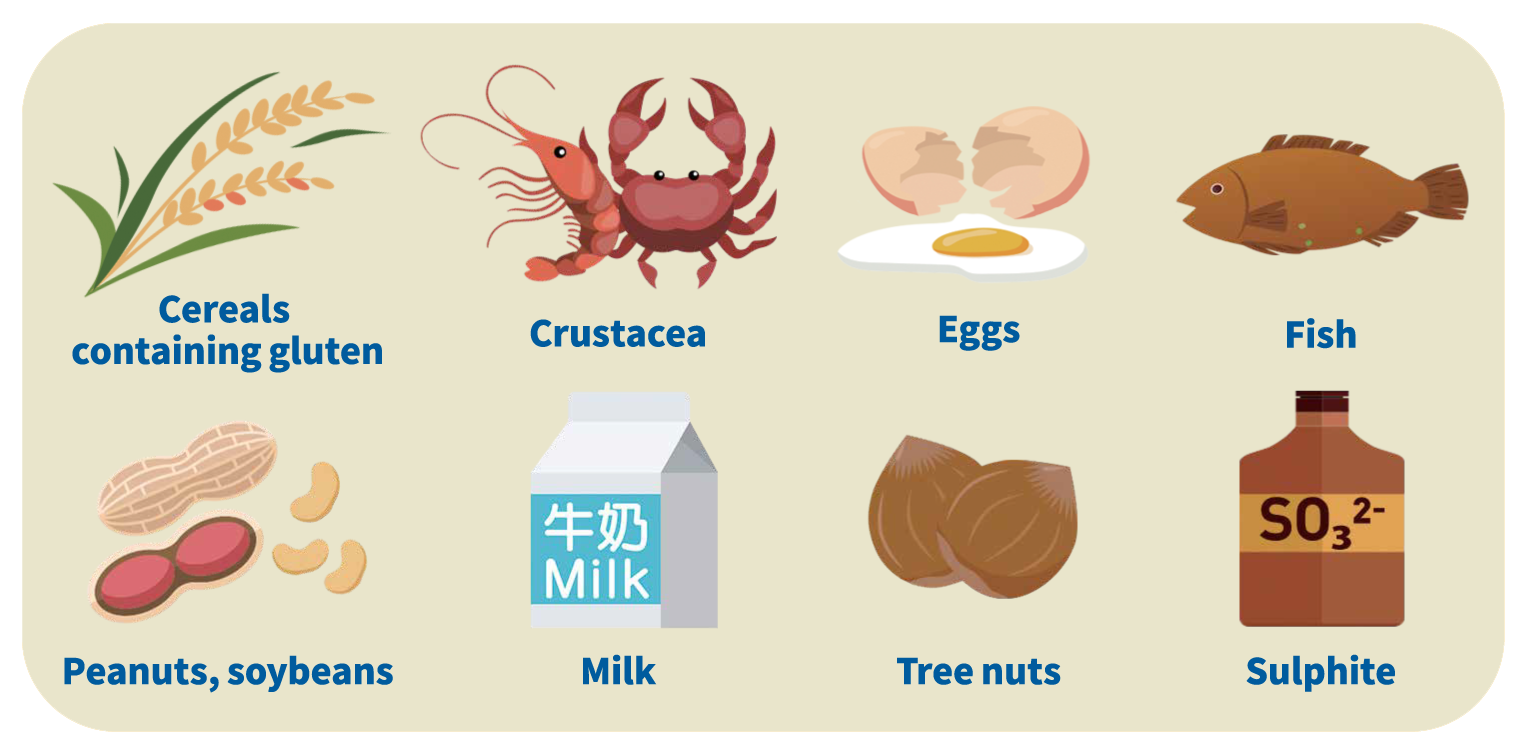
Allergens | Some typical examples of food item in which allergens may be found |
| Cereals that contain gluten (e.g. wheat, rye, barley and oats) | |
| Crustaceans (e.g. prawns, crabs and lobsters) | |
| Eggs | |
| Fish | |
| Milk | |
| Molluscs (e.g. mussels and oysters) | |
| Tree nuts (e.g. almonds, cashews, hazelnuts, pecans and walnuts) | |
| Peanuts | |
| Soybeans | |
| Sulphur dioxide and sulphites |
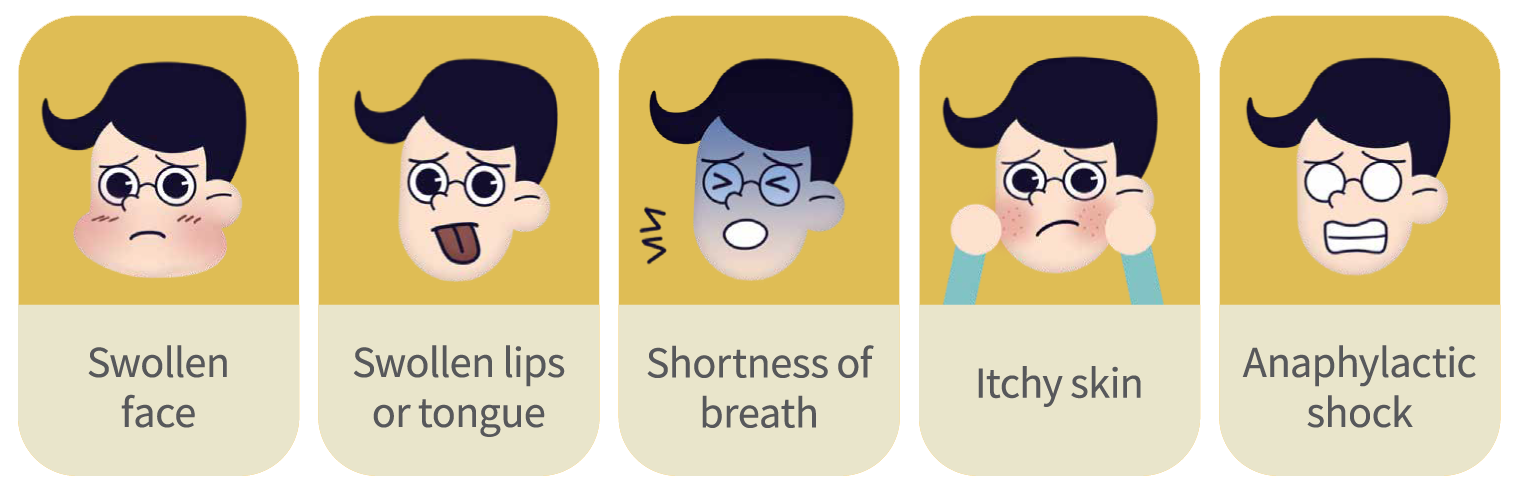
Symptoms of food allergy include swollen face, tongue or lips, shortness of breath and itchy skin. Anaphylactic shock, an acute, severe and potentially life-threatening allergic reaction may develop in severe cases.
Seek medical advice at once if the following symptoms develop after meal:
- Rash
- Swollen face
- Swollen tongue
- Swollen lips
- Shortness of breath
- Itchy skin
- Anaphylactic shock
Acute reaction
Generally occurs within a few minutes to an hour after contact with the allergen. Symptoms of acute allergy include:
- Difficulty breathing, tracheal constriction
- Loss of blood pressure
- Severe itching and redness of the skin
*Acute allergy may even be life-threatening. If this happens, you need to be sent to hospital for treatment immediately.
Chronic reactions
Usually occur within a few hours to one or two days after contact with the allergen. Symptoms of chronic allergies include:
- Itchy skin
- Rash, eczema
Food Allergy Test
Different allergic reactions require different testing methods, which can be roughly divided into 4 categories:
Skin prick test
Skin prick test is to gently prick the skin with food allergen extract, and use the skin's allergic reaction to measure the patient's allergy to the allergen. The reaction will occur within fifteen to twenty minutes. Skin prick tests are extremely sensitive and can test for many different allergens at the same time. Generally speaking, prick testing is safe, but there is a certain degree of risk in some extremely sensitive patients (such as those with peanut allergies). Therefore, such tests should be performed by an experienced physician.
Patch test
Patch test is a method to test chronic allergic reactions. The method is to apply the allergen extract to the skin and let the skin contact for 48 to 72 hours. This test is usually done to identify the allergen that is causing contact dermatitis, but it is sometimes needed to diagnose eczema.
Blood test
Blood samples are limited and can usually only be tested for a few different allergens each time. The cost is also relatively high. If a patient cannot undergo a skin test because of a skin problem or if medications suppress the results of a skin test, a blood test may be used instead. Blood tests are as accurate as skin tests but less sensitive. The degree of reaction can be used to follow the development of allergies.
Provocation Testing
Provocation testing is the gold standard for confirming food allergies. Provocative testing should be performed under the supervision of an experienced physician, initially with a small amount of food, then gradually increasing until a reaction occurs or a certain amount is reached.
Simple self-test for food allergies, Dr Berg
Desensitisation therapy
The best way to treat food allergies is to avoid the foods that cause allergies. However, if you are allergic to multiple similar foods, you may consider desensitization treatment.
Sublingual desensitisation therapy is a new approach to treat dust mite and pollen allergies. Recent studies have shown that treatment is effective in improving allergic rhinitis and asthma. The benefits of this treatment are convenience and safety.
During the treatment, the patient needs to eat a very small amount of the allergenic food, and then gradually increase the amount. After about three to four months, the patient's immune system will become tolerant to the allergenic food and will no longer have an allergic reaction. Because this treatment method has certain risks, the doctor needs to evaluate the patient before deciding whether to adopt this treatment option.
A recent study suggests that sublingual desensitization therapy is also effective for patients with peanut allergies.
The study was conducted at Duke University in North Carolina and Massachusetts General Hospital in Boston, USA. Eighteen children were given either a peanut allergen extract or a placebo in increasing doses at regular intervals. No one experienced severe allergic reactions during the experiment, and the only obvious adverse reaction was itching in the mouth. After 12 months, the patients who had received the allergen extract were able to eat 20 times more peanuts than those who had not received treatment. After treatment, patients were able to tolerate an average of 1700 mg of peanuts, equivalent to 6-7 peanuts. It is estimated that patients can consume peanuts regularly to maintain the effects of treatment.
How to avoid food with allergens?
Read food allergen information on food labels to identify if any food or food ingredients of your allergic concern are present in the food.
Avoid the food or food ingredients which you are allergic to.
Source:



