Description
🚚 The fastest delivery time : 2-day delivery.
🐝 Supplier / Origin : Local or domestic farms from China
🌱 Manufacturer introduction :
🛍 Product Information :
Jackfruit has a strong and pleasant aroma, and the pulp after opening is similar to the smell of pineapple and banana.
Since this fruit is not common in Hong Kong, many people don't know how to eat it.
It's a pity that the average consumer can't get meat for fear of trouble.
And it has a complication, that is, ordinary consumers deal with the thorny "jack fruit gum" (jackfruit slime) problem in the process of "fleshing" the jack fruit.
General cleaning agent treatment is not enough to clean.
Nutrition
The edible puree contains 74% water, 23% carbohydrates, 2% protein and 1% fat. The carbohydrate component is mainly sugars, which are a source of dietary fiber (table). Raw jackfruit provides 95 calories per 100 g (3.5 oz) serving and is a moderate source of vitamin B6, vitamin C, and potassium (10–19% of the DV) with low levels of other micronutrients (table).
Uncooked jackfruit
Nutritional value per 100 g (3.5 oz)
- Energy 397 kJ (95 kcal)
- carbohydrate
- 23.25 g
- Sugar 19.08 g
- Dietary Fiber 1.5 g
- Fat 0.64 g
- Protein 1.72 g
Vitamins and minerals
Other Ingredients Quantity
Full link to USDA database entry
†Percentages are estimated using U.S. adult recommendations, except for potassium, which is estimated using the National Academy of Sciences recommendations.
Jackfruit can partially solve the food security problem in developing countries.
Culinary Uses
Vegetarian Pulled Pork Jackfruit Burger
Ripe jackfruit is naturally sweet, with a light pineapple or banana-like flavor. It can be used to make a variety of dishes including custards, cakes, or mixed with shaved ice like es teler in Indonesia or halo-halo in the Philippines.
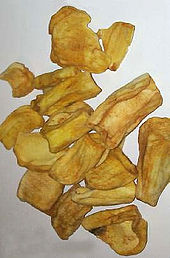
For idlis, a traditional breakfast dish in southern India, the fruit is served as a topping with rice and jackfruit leaves are used as a steamed wrap. Grind the jackfruit pulp with the batter to make jackfruit dosa. Ripe jackfruit arils are sometimes deseeded, fried or freeze-dried, and sold as jackfruit chips.
South East Asia
Potato chips (Kripik nangka; Indonesian)

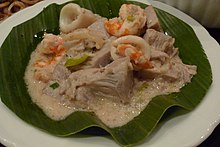
Ginataang langka, jackfruit in coconut milk (Philippines)
In Indonesia and Malaysia, jackfruit is called "nangka". The ripe fruit is often sold individually and eaten as is, or sliced and mixed with shaved ice to make sweet desserts such as es campur and es teler. The ripe fruit can be dried and fried to make kripik nangka, or jackfruit cookies. The seeds are cooked and eaten with salt as they contain edible starch; this is called concrete. Tender (unripe) jackfruit can be made into a curry (called gulai nangka) or a stew (called gudeg).
In the Philippines, unripe jackfruit or langka is often cooked in coconut milk and served with rice; this is called ginataang langka. The ripe fruit is often used to make local desserts such as halo-halo and turon in the Philippines. In addition to being eaten raw, the ripe fruit can also be preserved in syrup or dried. The seeds should also be cooked before consumption.
Thailand is a major producer of jackfruit, which is typically cut, prepared, and canned in syrup (or frozen in bags or boxes without syrup) and exported overseas, typically to North America and Europe.
In Vietnam, jackfruit is used to make jackfruit chè, a sweet dessert soup similar to Chinese bubble tea. The Vietnamese also use jackfruit puree as a pastry filling or as a topping for xôi ngọt (a sweet version of sticky rice).
Jackfruit is mainly distributed in eastern Taiwan. Fresh fruits can be eaten directly, or preserved as dried fruits, candied fruits or jams. It can also be stir-fried or stewed with other vegetables and meat.
Americas
In Brazil, three varieties are recognized: jaca-dura, or the "hard" variety, which has a firm flesh, and the largest fruits that can weigh between 15 and 40 kg each; jaca-mole, or the "soft" variety, which bears smaller fruits with a softer and sweeter flesh; and jaca-manteiga, or the "butter" variety, which bears sweet fruits whose flesh has a consistency intermediate between the "hard" and "soft" varieties.